
TL;DR

Get decor and gifts delivered free with Prime
- Fast, free delivery on millions of items
- Prime Video, Amazon Music and more included
- Member-only deals all year
Building an AI workstation used to be cheaper, but supply shortages and price spikes now make prebuilt options competitive or even cheaper. The choice depends on your needs for customization, support, and effort.
Imagine trying to assemble a high-powered AI workstation, only to find the GPU prices skyrocket overnight. That’s the reality in 2026, where supply chain chaos has flipped the traditional build vs buy debate.
Whether you’re a researcher, a hobbyist, or a professional, the decision isn’t just about saving money anymore. It’s about balancing cost, time, thermal management, and support. This article breaks down the latest landscape so you can make the smartest choice for your AI projects.
Build vs buy
an AI workstation.
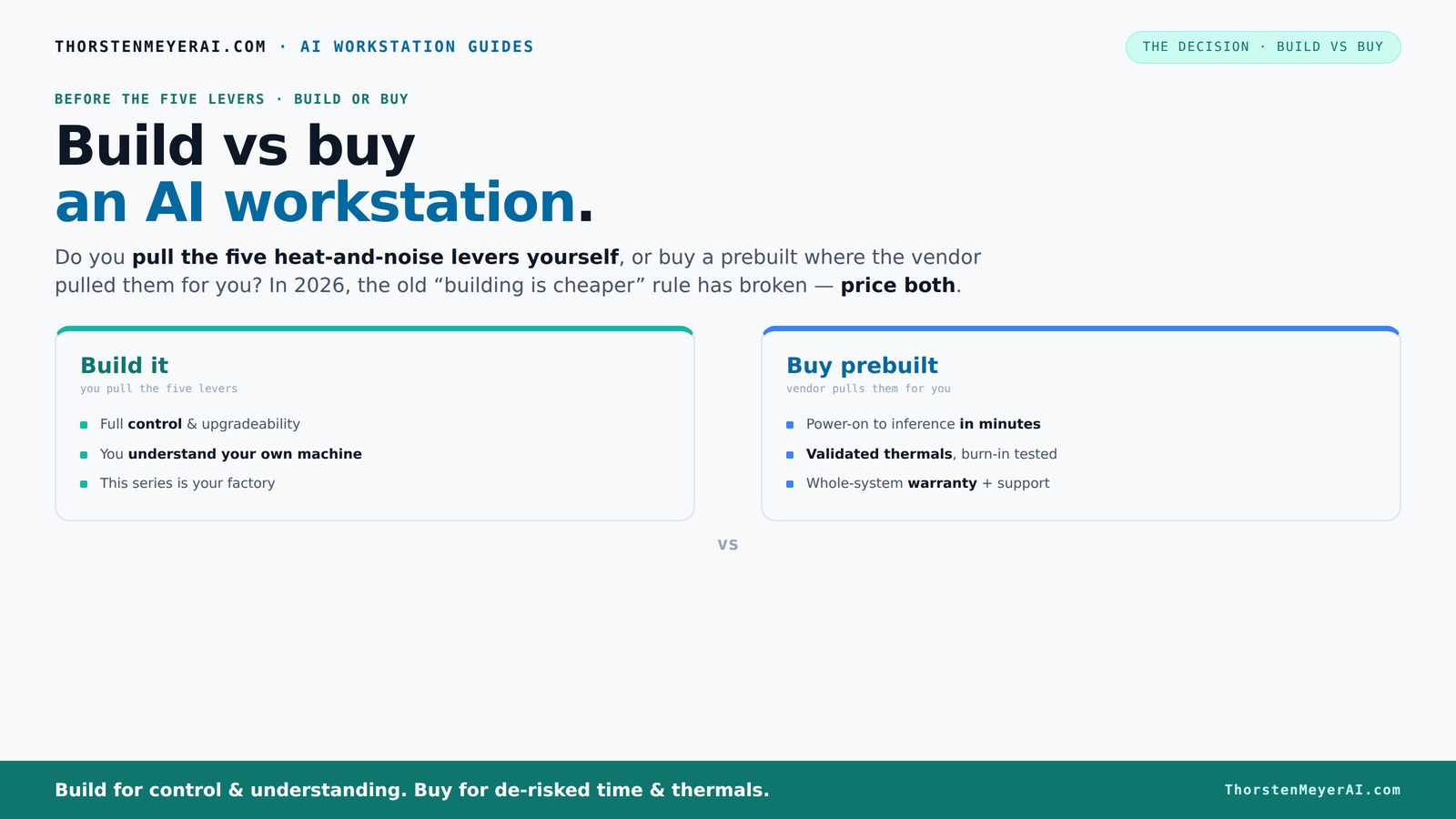
The real question behind this whole series: do you pull the five heat-and-noise levers yourself, or buy a prebuilt where the vendor pulled them for you? And in 2026, the old “building is cheaper” rule has broken. Match your situation in Part 3.
Key Takeaways
- Component shortages in 2026 have made DIY builds more expensive, often matching or exceeding prebuilt costs.
- Prebuilt workstations include validated thermals, robust support, and are ready to run—ideal for those with limited time or skills.
- Building offers maximum control for thermal tuning and upgrades, but requires technical know-how and time investment.
- Always compare prices for your specific configuration before making a decision, as the landscape shifts rapidly.
- The best choice balances your budget, skills, project timeline, and desire for customization.
prebuilt AI workstation with high-end GPU
As an affiliate, we earn on qualifying purchases.
As an affiliate, we earn on qualifying purchases.
Why Building Your Own AI Workstation Isn’t Always Cheaper Anymore
Building used to be the clear winner for cost, but that’s changed. The latest component shortages mean GPU prices have soared. For example, a top-tier NVIDIA RTX 4090 that cost $1,500 last year now often sells for $2,200 or more.
That means a full build with high-end parts can easily hit $4,000, while prebuilt systems from vendors like Lambda or Puget often come in at similar or even lower prices, thanks to bulk buying and optimized assembly.
So, the old rule — build for less — no longer applies across the board. Always price both options for your specific setup before deciding.
Beyond just cost, building your own system now involves deep considerations of supply chain stability. Relying on hard-to-find components can lead to delays, forcing you to compromise on your timeline or specifications. Additionally, the tradeoff is the time and effort spent in assembly and troubleshooting, which can offset the potential savings. The implications are clear: in some cases, buying prebuilt offers not just convenience but also a more predictable investment, especially when high-end parts are scarce.
The Five Levers of Heat and Noise — Who Controls Them?
Heat and noise are your biggest enemies in AI workstations. The question is: do you pull the levers yourself or let the vendor handle it?
If you build, you pick a quiet GPU, undervolt it, choose a case with good airflow, install sound-dampening materials, and tune the fans. For example, you might install a quiet CPU cooler and case fans to keep things cool without noise.
Prebuilt systems, on the other hand, come with factory-tuned fans, water cooling, and validated thermals. BIZON, for instance, advertises systems with up to 30% lower noise and temperature, tested under sustained load.
The control over heat and noise directly impacts the longevity and reliability of your system. Overheating can throttle performance and reduce hardware lifespan, while excessive noise can be distracting or intolerable in a work environment. Prebuilt systems often optimize these factors through professional thermal management, which can save you from costly upgrades or repairs down the line. Conversely, building your own allows for tailored cooling solutions, but it requires expertise to achieve the same level of thermal efficiency and silence. The tradeoff is clear: control versus convenience, with implications for ongoing maintenance and operational stability.
Performance and Upgradability: Which Path Wins?
Performance is king in AI, and both options can deliver top-tier results. But upgrading later? That’s easier if you build your own.
Building allows you to pick a motherboard with extra PCIe slots, more RAM slots, or better power delivery. Want to add another GPU in two years? You can plan for it now.
This flexibility means your investment can adapt over time, extending the useful life of your system. It also enables you to optimize for future AI workloads, which tend to grow more demanding. The tradeoff, however, is that prebuilt systems might come with limited upgrade options, especially if they use proprietary cases or smaller power supplies, which can restrict hardware compatibility. For example, a prebuilt with a compact chassis might not fit a second GPU or larger cooling solutions later. The implication is that building your own can be a smarter long-term choice if you anticipate hardware upgrades, but it requires planning and technical know-how upfront.
Cost Breakdown: Building vs Buying — The Real Numbers
| Factor | Build |
|---|---|
| Average cost of a high-end GPU (e.g., RTX 4090) | $2,200 |
| Other parts (CPU, RAM, storage, case) | $1,200 |
| Total for DIY build | $3,400 |
Compare that to a prebuilt with similar specs — often priced around $3,800 to $4,200, including warranty and support. The higher price of prebuilt systems reflects the economies of scale, professional assembly, and testing, which can actually make them more economical than DIY in some cases.
However, this comparison is not just about sticker price. Building your own system involves hidden costs—time spent researching compatible parts, troubleshooting issues, and assembling the hardware. This time investment can be significant, often adding 10–20 hours or more, which has value in itself. The tradeoff is that while building might save money upfront, it demands a level of technical skill and patience that not everyone has, and the hidden costs can sometimes outweigh the initial savings.
When Building Is Still the Better Choice
If you love tinkering, enjoy understanding every component, and want to optimize your system for your specific needs, building remains appealing.
For example, a hobbyist who wants a quiet, power-efficient rig for personal projects might choose to build, selecting quiet GPUs and specialized cooling.
Additionally, building your own system often results in better thermal performance, as you can select components and configurations tailored for optimal airflow and cooling, thereby reducing noise and extending hardware lifespan. Over the long term, this customization can translate into lower operational costs and more reliable performance. The tradeoff is that it requires time, effort, and a certain level of technical skill, which may not be feasible for everyone. For those who enjoy the process, however, the reward is a machine precisely tuned to their preferences, with potential savings and performance benefits.
When Buying Is the Smarter Move
If your time is limited, or you need a system ready to go yesterday, prebuilt is the way to go. It’s plug-and-play, with factory validation of thermals and often included support.
For instance, a data scientist who needs immediate access to a multi-GPU rig for deep learning training will benefit from a preconfigured system from Lambda or Puget.
Prebuilt systems also provide peace of mind through comprehensive testing, warranty coverage, and dedicated support channels. This reduces the risk of hardware incompatibility, setup errors, or thermal issues that can arise in DIY builds, especially for those less experienced. The implication is that prebuilt solutions are ideal for professionals who prioritize reliability and speed over customization, allowing them to focus on their work without hardware concerns.
The Final Call: Which Fits You?
The right choice depends on your priorities. If you crave control, customization, and enjoy the build process, go DIY. But if you prefer a reliable, supported, ready-to-run system, a prebuilt will save you headaches and time.
Remember, in 2026, the cost difference is less clear-cut. Always price your specific setup first. The real winner is the option that aligns best with your skills, schedule, and goals.
Frequently Asked Questions
Is building my own AI workstation cheaper than buying?
Not always. Due to supply chain issues and component shortages, building can cost as much or more than a prebuilt system with similar specs. Always compare prices for your exact setup before deciding.
How hard is it to assemble a high-end AI workstation?
It’s moderately challenging. You need to match compatible parts, install cooling properly, and configure BIOS settings. If you’re comfortable with hardware, it’s doable; otherwise, consider buying prebuilt for peace of mind.
Can I upgrade a prebuilt system later?
Yes, but upgrade options depend on the case size, power supply, and motherboard. Some prebuilt systems limit future upgrades, so check those details before purchasing if you plan to expand later.
What’s the best GPU for AI tasks in 2026?
NVIDIA’s A100, H100, or the RTX 4090 are top performers, depending on your budget. They offer excellent performance for training large models and inference workloads.
How long will my AI workstation last before needing an upgrade?
Typically 3–5 years, depending on workload intensity and hardware advancements. Regular upgrades can extend its usefulness.
Conclusion
In the end, whether you build or buy, your choice shapes how smoothly your AI projects run. If speed and support matter most, a prebuilt system is a smart bet. But if you love the puzzle of tuning your own rig, building can still be rewarding—just expect to pay a bit more in time and effort.
In 2026, the smartest move is to weigh both options carefully. The right system will power your AI journey, no matter how you get there.
Halloween Picks
halloween
As an affiliate, we earn on qualifying purchases.