To build a perfect spider web, choose the right materials like natural silk for flexibility and durability or synthetic fibers for strength and weather resistance. Start with a sturdy frame, then add radial lines and a sticky spiral, adjusting tension for elasticity. Reinforce weak spots and consider environmental factors like humidity and wind. Using precise techniques and lighter, fluffy materials creates an authentic, delicate look. Keep exploring to discover more tips for mastering web design.
Key Takeaways
- Select appropriate silk types, combining elastic and strong fibers to mimic natural web resilience and flexibility.
- Construct web structures with a central hub, radial lines, and sticky spiral for optimal strength and prey capture.
- Adjust web placement and design based on environmental factors like humidity and wind for durability and stability.
- Use lightweight, fluffy materials and precise tension control to create authentic, delicate, web-like aesthetics.
- Incorporate irregular patterns and gentle shaping techniques to enhance realism and visual appeal of the web.
Essential Types of Spider Silk
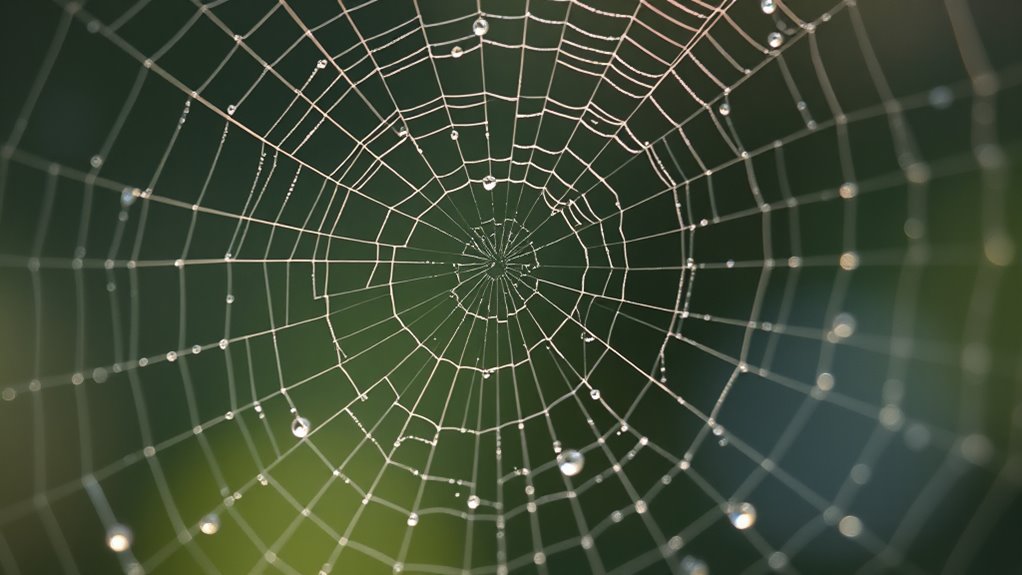
Have you ever wondered what makes spider silk so versatile and strong? It all comes down to the unique silk protein that composes each fiber. Different types of spider silk serve distinct purposes, each optimized for specific needs. For example, some silk is incredibly elastic, allowing the web to absorb impacts without breaking, while other silk offers unmatched fiber strength, making it tough enough to hold prey securely. The silk proteins in these fibers determine their properties, with variations in amino acid composition influencing elasticity and durability. Additionally, silk protein structures play a crucial role in defining these mechanical characteristics. By producing several silk types, spiders adapt their webs for various functions—whether for catching prey or creating safety lines. Understanding these essential silk types reveals how nature’s engineering combines multiple silk proteins to produce webs that are both resilient and efficient.
The Structure of a Perfect Web
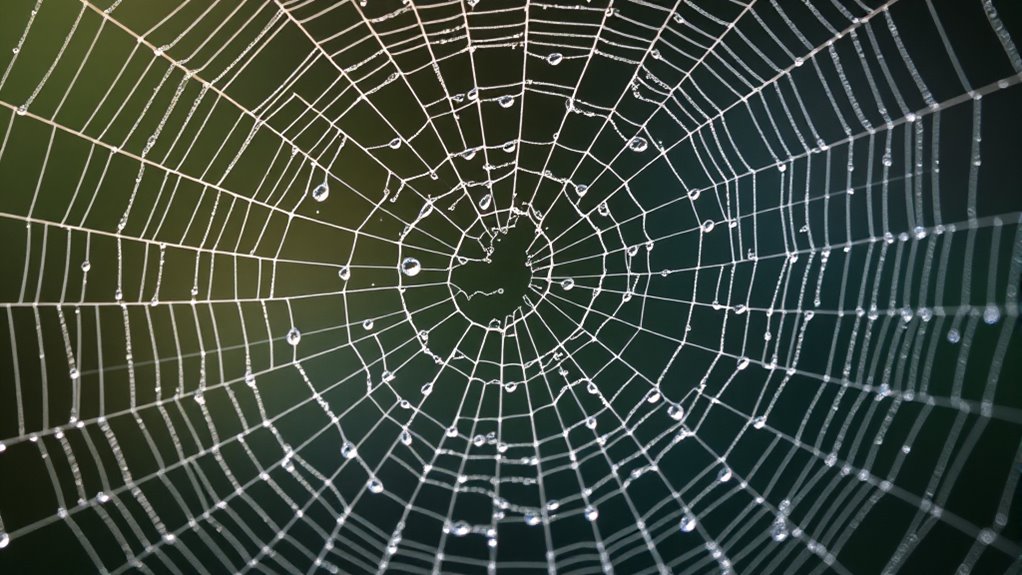
What makes a spider web truly perfect? It’s the flawless web symmetry that catches your eye, with each strand precisely positioned for maximum efficiency. A well-structured web isn’t just about looks; it provides strength and flexibility. Silk elasticity plays a vital role here, allowing the web to stretch without breaking when prey hits it. This elasticity absorbs shock and maintains the web’s integrity over time. A perfect web features a central hub with radiating spokes and a sticky, spiral capture zone. The balance of symmetry and silk’s flexible properties ensures the web can withstand environmental forces and prey struggles. Understanding air quality considerations highlights how environmental factors can impact web durability, emphasizing the importance of design and material properties in creating an exceptional web. Achieving this harmony between design and material properties is what elevates a spider web from functional to exceptional.
Selecting the Right Material for Web Building

When choosing materials for web building, you need to consider durability to ensure your web holds up over time. Natural fibers like silk offer flexibility and strength, while synthetic options can provide even greater resilience. Weighing these choices helps you select the best fibers for your web’s purpose and environment. Additionally, selecting materials that complement the rustic aesthetic of farmhouse decor can enhance the overall appearance and harmony of your space.
Choosing Durable Fibers
Choosing durable fibers is essential for ensuring that a spider web remains strong and functional over time. When selecting materials, focus on fiber strength, which determines how much tension the web can handle without breaking. Strong fibers resist snapping under prey’s struggles or environmental stress. Material elasticity is equally important, allowing the web to stretch slightly without snapping, which helps absorb shocks and maintain resilience. A highly elastic fiber can distribute force evenly across the web, reducing weak points. You want to choose fibers that balance both fiber strength and elasticity, ensuring durability and flexibility. This combination keeps the web intact longer, even in harsh conditions. Additionally, understanding the AI integration in device performance can inspire innovative approaches to designing more resilient and adaptive web materials. By prioritizing these qualities, you’ll build a web that’s both sturdy and adaptable, maximizing its effectiveness.
Natural vs. Synthetic Options
Have you ever wondered whether natural or synthetic fibers are better for building a durable spider web? Biological fibers, like silk from spiders, are flexible, elastic, and biodegradable. Synthetic filaments, on the other hand, are stronger and more resistant to weather, but less eco-friendly. Consider this comparison:
| Feature | Biological Fibers | Synthetic Filaments |
|---|---|---|
| Strength | Moderate | High |
| Elasticity | Excellent | Limited |
| Environmental impact | Biodegradable | Non-biodegradable |
| Durability | Sensitive to weather | Resistant to elements |
Choosing between these depends on your needs: natural fibers suit eco-conscious webs, while synthetic filaments offer longevity in harsh conditions.
The Step-by-Step Web Construction Process
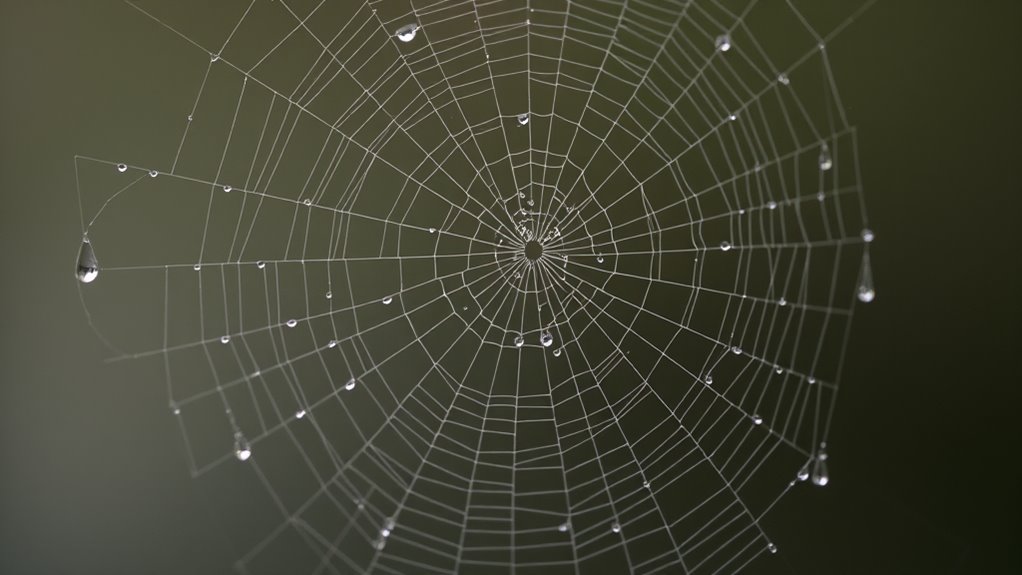
The process of building a spider web involves a series of precise and deliberate steps. First, you create the framework by web weaving, dropping a line that catches the wind and attaches to surfaces. Once secured, you reinforce this initial line with sticky silk, thanks to its unique properties, enabling efficient prey capture. Then, you add radial lines from the center outward, providing structure and support. To complete the web, you spin a sticky spiral inward, adjusting tension for ideal elasticity. Key steps include:
- Launching a silk line to establish the web’s outline.
- Reinforcing with strong, flexible radial lines.
- Spinning the sticky capture spiral for prey trapping.
Your understanding of silk properties and precise movements ensures a sturdy, effective web. Additionally, the material composition of silk plays a crucial role in the web’s durability and stickiness.
Techniques for Anchoring and Frame Creation
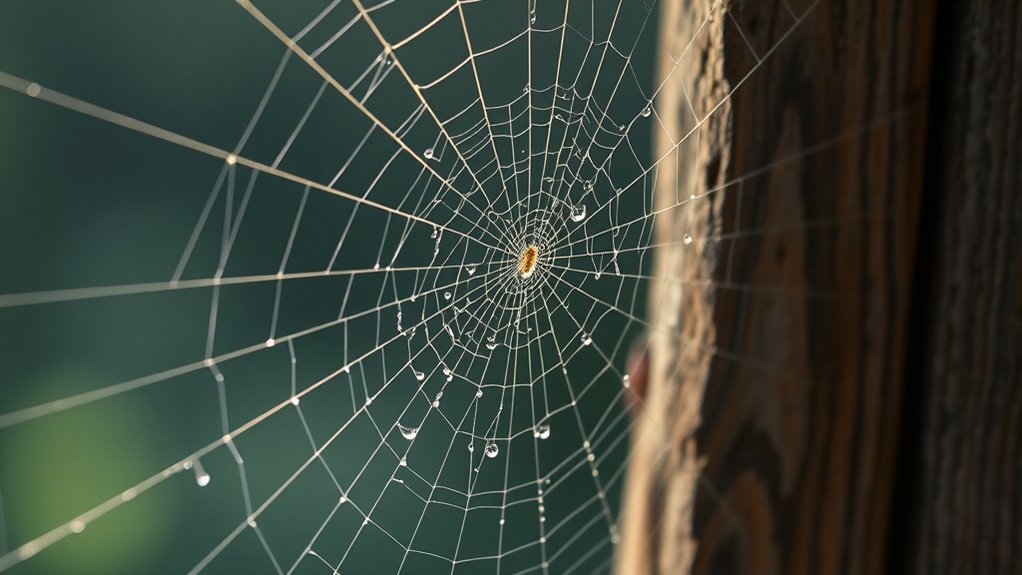
To create a stable foundation for your web, you need to master anchoring and frame techniques that guarantee durability and strength. Web anchoring involves attaching the initial catching threads to sturdy surfaces like branches, leaves, or other structures, ensuring the web stays secure. Use multiple anchor points to distribute tension evenly, which enhances stability. For frame construction, build a supportive outline by creating radial spokes that extend outward from the center, connecting the anchors. These spokes form the frame, providing a backbone for the sticky capture spiral. Keep your frame taut and well-spaced to prevent sagging or collapse. Proper web anchoring and precise frame construction are essential for a resilient, effective web capable of withstanding environmental forces. Additionally, understanding the contrast ratio of your web’s environment can help you optimize the web’s visibility and effectiveness against prey.
Creating the Sticky Capture Spiral
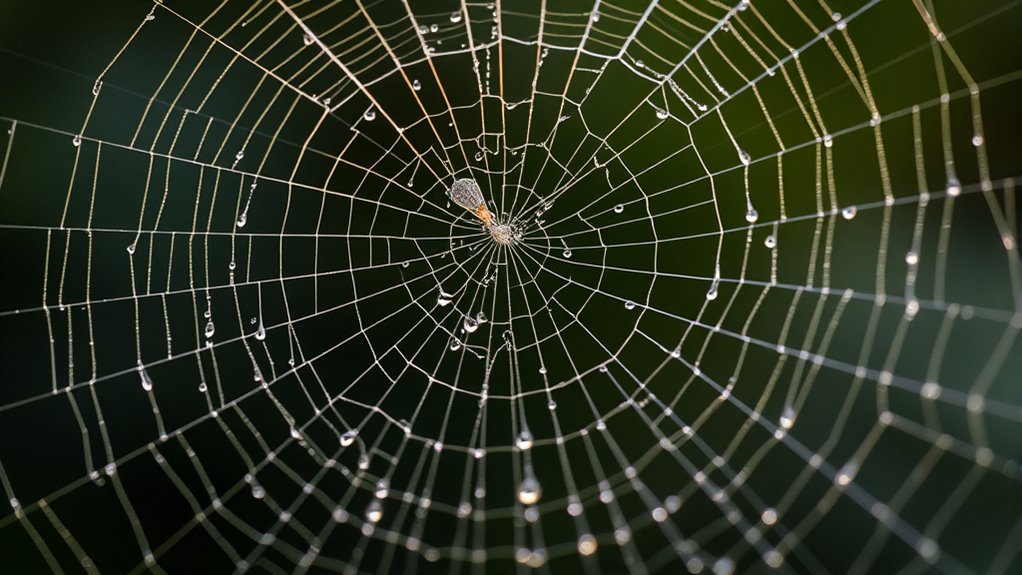
Once your frame is in place, you can begin creating the sticky capture spiral, which is the web’s main mechanism for trapping prey. Focus on forming a precise spiral design, starting from the center and working outward. As you build the spiral, you’ll add adhesive droplets along the silk thread, ensuring it’s sticky enough to catch insects effectively. Keep these tips in mind: User-friendly setup, Use a steady hand to maintain even spacing between the turns. Apply consistent amounts of adhesive droplets for uniform stickiness. Spin the spiral in a clockwise or counterclockwise direction for better web strength. This spiral design not only maximizes surface area for catching prey but also allows the web to absorb the impact of insects, making your web both effective and durable.
Reinforcing and Repairing Webs

After completing the sticky capture spiral, your web may face damage from prey struggling or environmental factors. To maintain its effectiveness, you’ll need to reinforce and repair it. Spiders use their own silk to mend tears, leveraging the adhesive properties of the sticky threads and the high tensile strength of the supporting frame. This ensures the web remains resilient and capable of capturing prey efficiently. When repairing, you might add new silk to reinforce weak spots or reattach broken strands. Keep in mind that proper tension preserves the web’s structural integrity. Here’s a quick overview:
| Reinforcement Technique | Purpose |
|---|---|
| Adding extra silk strands | Increase tensile strength and durability |
| Reattaching broken strands | Restores web’s integrity |
| Applying fresh adhesive | Improves capture efficiency |
| Tension adjustment | Maintains ideal web shape |
Additionally, understanding the materials used in web construction can help optimize repair techniques for better durability.
Environmental Factors Influencing Web Design
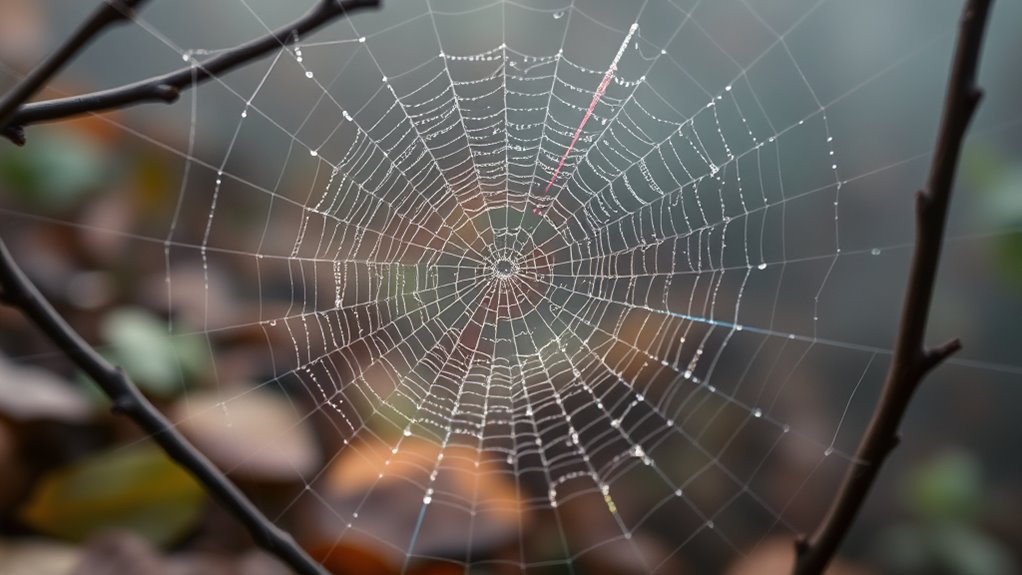
Environmental factors like humidity, wind, and surface texture play essential roles in how spiders design their webs. High humidity can weaken silk, while strong winds can challenge web stability, prompting adjustments in placement and structure. Surface textures, such as plant leaves or man-made surfaces, also influence where and how webs are built for maximum effectiveness. Additionally, understanding cybersecurity vulnerabilities is crucial for maintaining the integrity of web structures against digital threats.
Humidity’s Impact on Webs
Humidity plays a crucial role in shaping the structure and durability of spider webs. High humidity levels can increase humidity effects, making silk more elastic but also more prone to sagging or breaking under stress. Conversely, low humidity causes silk to become brittle, reducing its ability to stretch and absorb vibrations. To manage this, spiders excel at moisture control, adjusting their web-building techniques based on environmental conditions. They may also select specific locations or times for web construction to optimize humidity conditions. Environmental adaptation allows spiders to maintain web integrity across diverse climates, ensuring their webs remain effective and resilient.
Wind and Web Stability
Wind is a significant factor influencing the stability and effectiveness of spider webs. To withstand strong gusts, spiders often build their webs with an aerial suspension design, allowing the web to sway and absorb wind energy. The silk’s flexibility enhances wind resistance, preventing tears or collapse. Spiders choose locations that minimize exposure to high winds, such as sheltered corners or between sturdy branches. They also reinforce the web’s anchor points to maintain stability during gusts. By adjusting the web’s tension and structure, spiders optimize their webs for environmental conditions, ensuring they remain functional even in breezy conditions. Understanding the importance of wind and aerial suspension helps you appreciate how spiders adapt their web-building techniques to maximize durability and prey capture efficiency. Additionally, the material composition of the silk plays a crucial role in its ability to withstand environmental stresses and maintain web integrity over time.
Surface Texture Effects
Surface texture plays a crucial role in how spiders design their webs to effectively capture prey and adapt to their surroundings. You’ll notice that rough or textured surfaces can lead to debris accumulation, which may weaken the web or make it more visible to prey. To counter this, spiders often incorporate web camouflage, blending their webs into the environment for better concealment. They also choose surfaces with ideal textures to prevent debris buildup and maintain web integrity. Additionally, some spiders modify web placement based on environmental textures, optimizing stability and concealment while considering material durability.
Comparing Natural and Artificial Web Materials
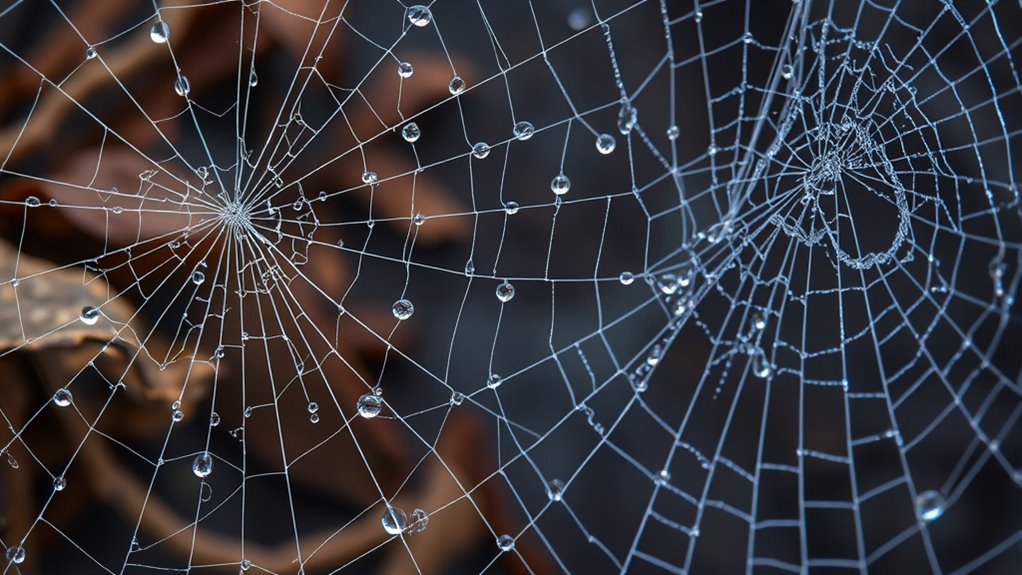
While natural silk has evolved over millions of years to be lightweight, elastic, and incredibly strong, artificial web materials often aim to replicate these properties using synthetic fibers. Natural silk boasts exceptional biological properties, such as high tensile strength and elasticity, which allow spiders to build durable webs that withstand environmental stresses. In contrast, artificial web materials focus on material durability, ensuring longevity and resistance to wear and tear. Synthetic fibers like nylon or polyester can mimic the flexibility and strength of natural silk, but they sometimes fall short in biological properties like biodegradability or self-repair. Overall, while artificial options improve in durability, matching the full biological complexity of natural spider silk remains a challenge. Additionally, ongoing research into biomimicry seeks to develop synthetic materials that better replicate the unique properties of natural spider silk.
Tips for Mimicking Spider Web Techniques

To mimic spider web techniques effectively, you should use sticky string selectively to replicate the web’s grip. Creating irregular patterns makes your web look more authentic and natural. Additionally, employing light, fluffy materials can help achieve the delicate, airy appearance of real spider webs. For added realism, consider incorporating preppy dog names that evoke a sense of style and sophistication, enhancing your overall design.
Use Sticky String Wisely
Using sticky string effectively requires careful placement and tension to mimic a spider’s web without causing unnecessary mess or waste. To maximize adhesive properties, stretch the string just enough to maintain tension without over-tightening, which can cause breakage. Proper tension maintenance ensures the web stays intact and looks realistic. Additionally, understanding natural web-building techniques can help in replicating the structural stability seen in real spider webs automation in business.
- Test the string’s adhesive properties on a small area first to avoid unexpected messes.
- Keep a steady hand to maintain consistent tension while attaching strands.
- Use tools like tweezers or clamps to help control tension and placement precisely.
Create Irregular Web Patterns
Creating an irregular web pattern involves intentionally varying the angles, spacing, and strand lengths to mimic a real spider’s web. Focus on irregular patterning by deliberately shifting strand angles as you work outward from the center. Avoid uniformity; instead, create an asymmetrical design where spokes and threads differ in length and position. This approach adds authenticity, making your web look more natural. Use loose, freehand movements to introduce spontaneous variations, rather than rigid, symmetrical lines. Incorporate small deviations intentionally, like slightly uneven gaps or varying distances between the radial lines. This irregular patterning enhances realism and captures the chaotic beauty of actual spider webs. Remember, the key is embracing imperfection to evoke the organic, unpredictable nature of real webs. Developing a keen eye for visual authenticity helps ensure your web captures the true essence of a spider’s intricate design.
Employ Light, Fluffy Materials
Light, fluffy materials are essential for mimicking the delicate, airy quality of real spider webs. They help create the web aesthetics that make your design believable and enchanting. To achieve this, consider using materials like cotton candy, spun sugar, or fine tulle. These options provide the right softness and volume to replicate web threads. You can also experiment with lightweight synthetic fibers or even shredded silk for a more authentic look. When shaping your web, gently stretch and arrange the materials to mimic natural web patterns, avoiding stiff or bulky strands. Remember, the goal is to keep everything light and airy, emphasizing the web’s fragile appearance. Incorporating these light, fluffy materials gives your project an authentic, delicate feel that truly captures the essence of spider web artistry.
Frequently Asked Questions
How Do Spiders Decide Where to Build Their Webs?
You can see that spiders decide where to build their webs based on web placement, which they often choose in areas with high insect traffic or favorable structures. They assess the surroundings and select spots with stable anchor points. Silk selection also matters; they use strong, sticky silk for the web’s foundation and capture threads. By analyzing environmental cues, they optimize their web’s location for catching prey effectively.
Can Humans Replicate Spider Web Strength With Artificial Materials?
Sure, you can replicate spider web strength with synthetic silk, achieving astonishing tensile strength. By blending advanced fibers, you create materials that mimic the resilience and flexibility of natural webs. Synthetic silk’s strength surpasses steel per weight, making it a marvel of modern materials science. With clever crafting, you can develop durable, lightweight structures—proving that human ingenuity can match, even master, nature’s most marvelous, web-weaving wonders.
What Are Common Challenges in Constructing Spider Webs Artificially?
You face common challenges like adhesion problems and maintaining structural stability when constructing spider webs artificially. Ensuring the silk adheres properly without slipping is tricky, especially under varying weather conditions. Additionally, replicating the web’s intricate design while keeping it strong enough to withstand tension requires precise materials and techniques. These issues make it difficult to create artificial webs that mimic the durability and flexibility of natural spider silk.
How Do Environmental Changes Affect a Spider’s Web-Building Behavior?
Climate influence and habitat disruption can markedly alter your web-building behavior. As temperatures rise or humidity shifts, you might notice changes in web size or silk quality. Habitat disruption forces you to adapt, possibly leading to less intricate or less stable webs. These environmental changes challenge your instinctual patterns, making it harder to catch prey or defend your territory. Your ability to adjust depends on how quickly you respond to these shifting conditions.
Are There Any Safety Concerns When Mimicking Spider Web Techniques?
When mimicking spider web techniques, safety precautions are essential. You should wear gloves and eye protection to prevent cuts from sharp materials, and make certain good ventilation if using adhesives or chemicals. Be aware of hazards like falling or tripping, especially when working at heights or in awkward positions. Always prioritize hazard awareness, follow instructions carefully, and avoid using toxic substances to keep yourself safe while recreating spider web designs.
Conclusion
Now that you’ve uncovered the secrets behind spider web craftsmanship, you’re practically a web-building wizard. With the right materials and techniques, you can create structures more intricate than the most complex labyrinths. Remember, mastering these skills puts you in a league where even the most talented humans seem like amateurs. So go ahead—grab your tools, embrace the process, and craft webs so stunning they could make the universe itself stop and stare.