
TL;DR

Get decor and gifts delivered free with Prime
- Fast, free delivery on millions of items
- Prime Video, Amazon Music and more included
- Member-only deals all year
Interior designer Natalie Jahangiry has outlined four decorating principles she uses as flexible guides: the 60-30-10 colour ratio, an unexpected red accent, grouping objects in threes and paying attention to scale. Her Ideal Home article presents them as personal advice, not rules that every homeowner must follow.
Interior designer Natalie Jahangiry has shared four decorating principles she uses to make rooms feel more balanced: a loose 60-30-10 colour split, an unexpected red accent, grouping accessories in threes and checking the proportions of furniture, rugs and artwork. In an Ideal Home Open House article, she stresses that the ideas are guides rather than strict rules, reflecting her view that a home should suit its occupants and their tastes.
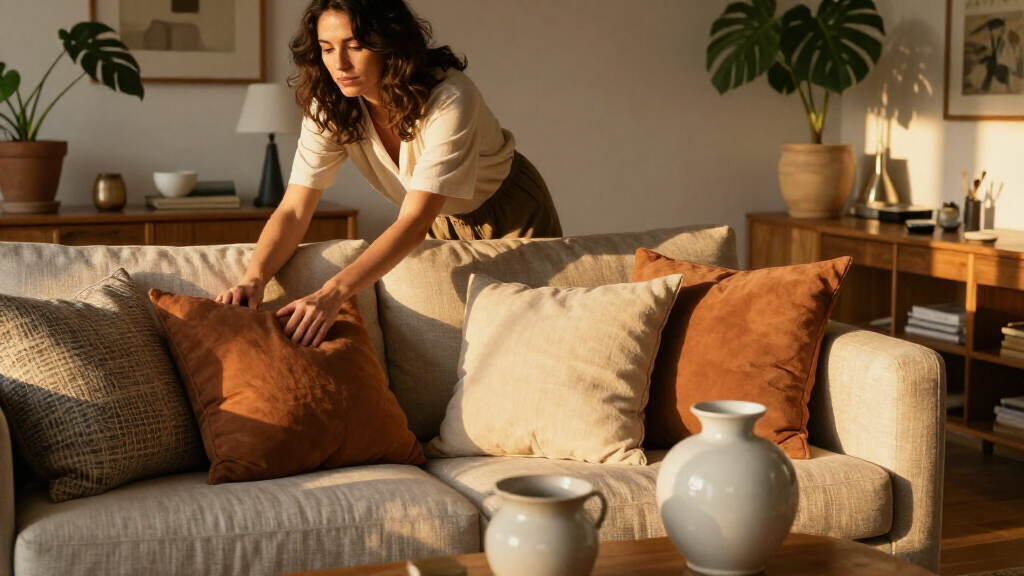
Jahangiry describes the 60-30-10 approach as a starting point for building a colour scheme. One colour forms roughly 60% of the room, often through walls or large furniture; a complementary shade accounts for about 30%, perhaps in upholstery, curtains or a rug; and a final 10% can come from smaller accents such as artwork or cushions. She says the balance can help a scheme feel considered, especially when using bolder colours or mixing styles, but does not calculate the proportions literally.
Her second suggestion is the unexpected red theory: adding a red object to a room where red is not otherwise prominent. The idea was popularised in an early 2024 TikTok post by Brooklyn-based interior designer Taylor Migliazzo Simon, according to Jahangiry. The accent might be a vase or lamp, or a larger item such as a chair or rug. Jahangiry says the useful principle is less about red itself than about introducing an unexpected contrast.
For styling surfaces, Jahangiry says she often arranges accessories in groups of three, varying their height, shape and texture. She says the broader idea can work with other odd-numbered groups, too. Her most consistent principle is proportion: a living-room rug should generally extend under at least the front legs of the sofa and nearby chairs, while artwork above a large sofa should be sized to relate to the furniture rather than appear undersized.
Four Guides for More Balanced Rooms
The advice gives readers a practical way to diagnose why a room may feel unfinished or visually uneven without requiring a full redesign. A colour ratio can help someone choose a starting palette; a contrasting object can add visual interest; grouping accessories can make a surface feel deliberate; and checking scale can connect separate furnishings into a more coherent arrangement.
These are design suggestions, not evidence-based guarantees that a room will look better. Jahangiry presents them as techniques she personally finds useful, with the judgement left to the homeowner. That distinction matters for people decorating family homes, where function, existing belongings and individual preferences may not fit a fixed formula.
As an affiliate, we earn on qualifying purchases.
Advice From an Open House Contributor
Ideal Home describes Jahangiry as one of its new Open House contributors, writing about decorating for busy family life while maintaining personal aesthetic values. In this article, she builds on her stated preference for following instinct rather than treating traditional interior design rules as instructions.
The four ideas also differ in how rigidly they can be applied. Jahangiry says the 60-30-10 balance may not suit a room drenched in different tones of one colour, and she recommends trusting the eye rather than doing the maths. The red-accent concept is presented as a way to introduce contrast, while her advice on proportion focuses on how individual objects relate to nearby furniture and the room as a whole.
No One-Size-Fits-All Formula
The article is a designer’s account of techniques she finds helpful, not a comparative study testing whether these approaches improve a room or suit every home. It gives no measurements for choosing a rug or artwork beyond their relationship to surrounding furniture, and it does not establish that a red accent will work in every colour scheme. Readers’ layouts, budgets, household needs and tastes will differ.
Jahangiry also does not specify a single alternative for colour-drenched rooms or every possible arrangement of accessories. Her position is that the principles should be adapted or set aside when they do not fit the space.
Apply the Ideas to Your Room
The article does not announce a product, formal design standard or further project milestone. For readers, the next step is to test the ideas against an existing room: look at the balance of its main colours, consider whether one contrasting accent would add interest, group small accessories intentionally and check whether rugs and artwork relate in scale to the furniture around them.
Jahangiry’s stated approach leaves the final decision with the homeowner: use the principles that support the room’s function and personal style, rather than treating any of the four as compulsory.
Key Questions
What are the four interior design principles Jahangiry recommends?
She recommends using the 60-30-10 colour approach, adding an unexpected red accent, grouping accessories in threes and paying attention to proportion and scale.
Does the 60-30-10 rule require exact measurements?
No. Jahangiry describes it as a loose guide to balancing a dominant colour, a secondary colour and a smaller accent. She says she trusts her eye rather than calculating exact percentages.
Does the unexpected accent have to be red?
Jahangiry says the idea is less about red itself than about introducing an unexpected contrast. The original red theory, as she describes it, uses red as the accent colour.
How should a living-room rug relate to a sofa?
Jahangiry suggests choosing a rug large enough to sit under at least the front legs of the sofa and nearby chairs, helping visually connect the seating area.
Are these rules meant to work in every home?
No. Jahangiry presents them as flexible principles, not rules to follow blindly. She says homeowners should use the ideas that suit their room and personal preferences.
Source: rss
Halloween Picks
halloween
As an affiliate, we earn on qualifying purchases.