
TL;DR

Get decor and gifts delivered free with Prime
- Fast, free delivery on millions of items
- Prime Video, Amazon Music and more included
- Member-only deals all year
A project featured by Hunker shows BK Woodworking building a folding table from reclaimed pallet wood and mounting it beneath a window. The hinged design folds against the wall for use as a narrow ledge, but the report says it must be fastened to wall studs to support weight.
A BK Woodworking DIY video featured in a Hunker report shows a maker turning reclaimed pallet boards into a wall-mounted folding table that tucks away as a narrow ledge when not in use. The project offers a space-saving furniture option for small rooms, while relying on sound preparation of the salvaged wood and secure attachment to wall studs.
In the video described by Hunker, the maker first removes nails from the pallets, sands the boards and runs them through a planer before cutting them down. The finished tabletop uses eight one-by-two boards, spaced with small gaps and joined underneath by perpendicular cleats. A one-by-eight board forms the main wall ledge, while hinges connect the table and its folding support.
The support structure uses additional one-by-twos and one-by-fours. The one-by-fours meet beneath the back of the table to form a shelf-like support for the ledge; a hinged, triangular brace folds beneath the table when it is raised. The project also calls for wood screws, a brad nailer and wood filler. Hunker says the tabletop should be filled and sanded again to produce a smoother finish.
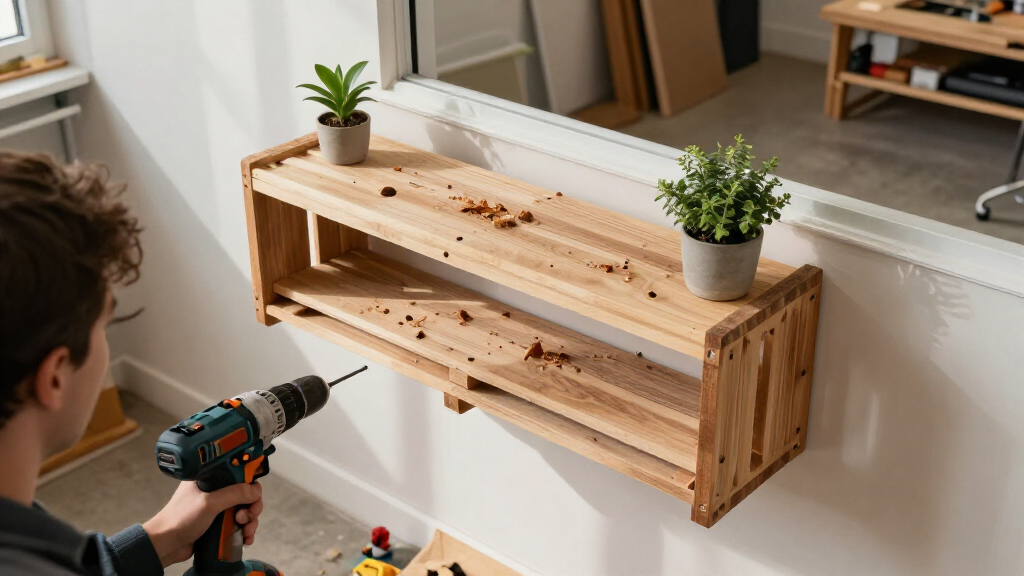
When folded up, the table sits against the wall beneath a window and can function as a ledge for decorative items, according to the report. Hunker cautions that this design needs to be fixed directly to wall studs to hold meaningful weight. It also notes that a laser level may help with even installation. The report does not provide measurements, a tested weight limit or a cost estimate.
A Foldaway Surface for Small Rooms
The design addresses a practical space problem: a conventional table takes up floor area even when no one is using it. A folding surface can be lowered when needed and returned to a slim wall-mounted position afterward, making the idea relevant to compact homes, work corners or rooms with limited space. Its raised position also gives the piece a second use as a display ledge.
Using reclaimed boards may reduce the amount of new lumber needed, and Hunker notes that pallets can sometimes be found free. But free material does not mean a finished project has no cost: the maker still needs hardware, tools and time, and the source gives no figures for these. Nor does the report establish how much weight the finished table can safely carry. The stud-mounted installation is a key condition, not a minor finishing detail.
As an affiliate, we earn on qualifying purchases.
From Pallet Boards to Hinged Table
Hunker describes pallets as a possible source of wood for furniture projects, provided the boards are made usable through steps such as nail removal, sanding and planing. The featured build converts the salvaged material into narrow tabletop boards and support pieces rather than using an intact pallet as furniture. That preparation is central to the project: the boards must be trimmed and joined into a stable surface.
The article also outlines the sequence shown in the video: prepare and cut the lumber, space and fasten the tabletop boards, attach the ledge with hinges, then build the folding support. Hunker mentions other uses for spare pallet wood, including concealing outdoor trash cans, but its report focuses on the folding table. It does not identify the wood species, the pallet’s previous use or any treatment applied before construction.
““The table attaches directly to his wall beneath a window, and when it’s not unfolded, it makes for a nice ledge to put decor pieces on.””
— Hunker, describing the pallet-wood project
Load Rating and Build Details
The Hunker report does not state the table’s dimensions, the weight it can support, the type or condition of the pallet wood, or the exact mounting hardware used. It also provides no independent test of the structure or evidence that every pallet is appropriate for indoor furniture. The video is described as demonstrating the build, but the source does not report a professional safety review or long-term performance testing.
Readers should not treat the project as a rated work surface based on the article alone. The report’s warning says the table should attach to wall studs; it does not give instructions for different wall constructions or specify how to confirm that a particular installation is secure.
Check the Build Before Use
Hunker points readers to the BK Woodworking video for the project demonstration, but its report gives no announced follow-up, testing milestone or update. Anyone considering a similar build would need to confirm the condition and suitability of the pallet wood, select appropriate hinges and fasteners, and plan a secure stud-mounted installation before putting weight on the table.
The finished piece’s safe capacity remains unreported. Until that is known, the table should not be assumed suitable for heavy loads or tasks that could put sudden force on its surface.
Key Questions
What does the DIY project make?
It makes a wall-mounted folding table from prepared pallet boards. When raised, the table folds against the wall and can serve as a narrow ledge.
What materials and tools does the report list?
Hunker describes eight one-by-two boards for the tabletop, additional one-by-twos and one-by-fours for the support, a one-by-eight ledge board, hinges, wood screws, a brad nailer and wood filler. The source does not give a complete cut list or project cost.
How should the folding table be attached?
Hunker says it should be fastened directly to wall studs and suggests a laser level may help keep the installation even. The report does not provide a weight rating or instructions for every wall type.
How much weight can the table hold?
The source does not say. It warns that the table will not hold much weight unless attached to wall studs, but gives no tested load limit.
Does the report establish that all pallets are suitable for furniture?
No. The report describes removing nails, sanding and planing the boards, but does not identify the featured pallet’s history, wood type or treatment. It does not claim that every pallet is suitable for indoor use.
Source: rss
Halloween Picks
halloween
As an affiliate, we earn on qualifying purchases.