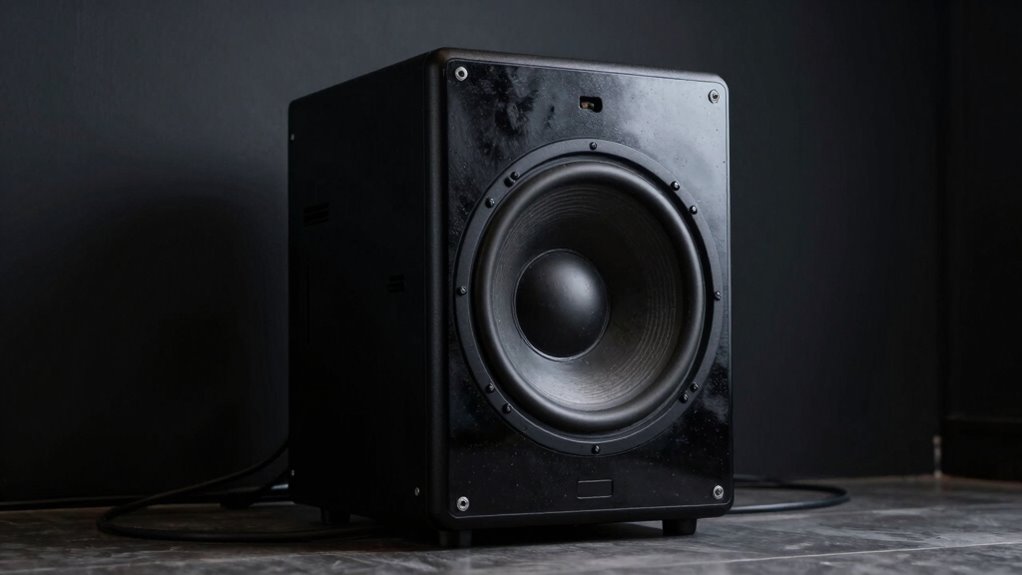
To feel deep, visceral bass, start by experimenting with your subwoofer’s placement, ideally along the front wall near your main speakers. Walk around your room, listen for spots where bass feels tight and powerful, and avoid fixed positions without testing. Positioning near corners or walls can boost bass but may cause boominess—adjust accordingly. Fine-tuning level and phase helps blend it smoothly. Keep trying different spots to unleash that immersive, dread-inducing bass you crave; there’s more to discover.
Open a free Amazon Business account
Business pricing, bulk buying and tax-exempt orders.
As an affiliate, we earn on qualifying purchases.
Key Takeaways
- Proper subwoofer placement enhances deep, visceral bass that you can physically feel, creating a sense of ‘dread.’
- Experimenting with different locations, especially near walls or corners, boosts bass response and intensity.
- Room acoustics and reflections significantly influence bass depth; adjusting placement mitigates negative effects.
- Fine-tuning level and phase controls helps integrate the subwoofer for powerful, balanced bass.
- Patience and testing are essential to find the position that delivers impactful, immersive low-frequency sound.
Are you unsure where to position your subwoofer for the best sound? Finding the right spot can make a huge difference in how your system performs, especially when it comes to achieving that deep, visceral rumble that makes movies and music feel alive. To start, it’s essential to understand that the subwoofer’s placement directly influences its frequency response, which is how well it reproduces the full range of low frequencies. If it’s placed poorly, you might notice that bass sounds muffled, boomy, or uneven. Conversely, ideal positioning ensures smooth, powerful bass that complements your overall sound system.
Room acoustics play a significant role in how your subwoofer performs. Every room has unique reflective surfaces, corners, and dimensions that can amplify or dampen bass frequencies. When you position your subwoofer improperly, you risk creating standing waves or null points—areas where certain bass frequencies cancel each other out—resulting in uneven sound. To avoid this, try placing the subwoofer near a wall or corner, as these spots often boost bass response by reinforcing low frequencies. But don’t just blindly shove it into a corner; instead, experiment with different locations to find a sweet spot where the bass feels balanced and natural.
A practical approach is to start by placing your subwoofer along the front wall, close to your main speakers, because this tends to produce the most cohesive sound. Then, walk around your room while the system is playing, paying attention to how the bass feels in different spots. You might notice areas where it feels more intense or lacking. Moving the subwoofer slightly and listening carefully helps you identify a suitable position that offers a balanced frequency response. Remember, the goal isn’t just loud bass, but a deep, clean sound that integrates seamlessly with your other speakers. Understanding room acoustics and their impact on bass response is crucial for optimizing your setup. Additionally, proper subwoofer placement can help prevent issues like standing waves and frequency cancellations that negatively affect sound quality.
Furthermore, take advantage of subwoofer crawl techniques—move the sub around the room while listening to a bass-heavy track until you find a spot where the sound is tight and even. Once you identify that location, you can secure the subwoofer there and fine-tune its level and phase controls for the best integration. It’s also helpful to consider room dimensions and their influence on sound behavior when choosing a placement. Adjusting for room furniture and objects can significantly improve bass clarity and avoid unwanted resonances, making your listening experience more immersive. Keep in mind that furniture, curtains, and other objects affect room acoustics, so adjusting your setup based on the room’s characteristics will help you achieve that “dread” you want—the kind of bass that you can feel deep in your bones. In the end, mastering subwoofer placement is about patience, experimentation, and understanding how your room’s unique acoustics influence sound quality.
As an affiliate, we earn on qualifying purchases.
Frequently Asked Questions
How Does Room Size Affect Subwoofer Placement?
Room size greatly influences subwoofer placement because larger rooms require you to take into account room acoustics and speaker integration carefully. In bigger spaces, you might need to position your subwoofer closer to walls or corners to enhance bass response, while smaller rooms demand more precise placement to prevent boomy sounds. Adjusting placement based on room size ensures balanced sound, minimizes echoes, and creates a more immersive experience.
Can Multiple Subwoofers Improve Sound Quality?
Think of multiple subwoofers as a symphony of bass, creating a richer, more immersive sound. They can markedly improve sound quality when you focus on proper subwoofer calibration and isolation. By distributing bass evenly across the room, you reduce dead spots and minimize distortion. This setup enhances clarity and depth, making you feel the music rather than just hear it—turning any space into a bass sanctuary you’d never want to leave.
What’s the Best Height for Positioning a Subwoofer?
You should position your subwoofer near the floor and close to walls for ideal bass response. The best height is generally at or slightly above floor level, but always calibrate your subwoofer afterward to guarantee balanced sound. Incorporate acoustic treatments around the room to reduce unwanted resonances. Proper subwoofer calibration helps achieve even bass distribution, making your setup sound immersive and powerful without overwhelming other frequencies.
How Do Furniture and Decor Impact Subwoofer Performance?
Think of your furniture and decor as the stage curtains for your subwoofer’s performance. They influence sound waves, either dampening or amplifying vibrations. Subwoofer aesthetics matter so it blends seamlessly, avoiding visual clutter. Decorative integration ensures your subwoofer complements your space, preventing sound from bouncing unpredictably. You want the aesthetics to support, not sabotage, the immersive experience. Proper placement amidst furniture enhances bass response, creating a powerful, cohesive atmosphere.
Is There a Difference Between Ported and Sealed Subwoofers in Placement?
Yes, there’s a difference between ported and sealed subwoofers in placement. Ported subwoofers, with their vented enclosure types, need more space around them to avoid sound distortion and port noise. Sealed subwoofers, with airtight enclosures, are more flexible, fitting into tighter spots without loss of sound quality. When choosing placement, consider these enclosure types to maximize bass response and reduce unwanted vibrations.
Conclusion
By placing your subwoofer thoughtfully, you create a space where bass feels balanced, immersive, and powerful. Proper placement transforms your listening experience into a harmony of depth and clarity, where sound flows seamlessly, vibrations resonate perfectly, and the music surrounds you completely. When you position your subwoofer wisely, you invite a world of rich, precise, and felt sound—where every beat, every bassline, and every note becomes a tangible part of your space.
Grilling season Picks
grills
As an affiliate, we earn on qualifying purchases.