
TL;DR

Get decor and gifts delivered free with Prime
- Fast, free delivery on millions of items
- Prime Video, Amazon Music and more included
- Member-only deals all year
A Hunker report outlines a DIY shoe-storage shelf built from six standard concrete blocks and three plywood boards. The project can be painted or stained and arranged with open shoe storage, baskets or a curtain; the source does not provide tested load limits or safety certification.
A DIY shoe-storage design shared by BEHR Paint uses six concrete blocks and three plywood boards to make a three-level shelf, according to a report from Hunker. The arrangement offers an alternative to a conventional metal shoe rack, but the source gives no tested load rating or formal safety assessment.
The project calls for six blocks measuring 8 by 8 by 16 inches and three matching plywood pieces, each 16 inches wide. The board length is flexible, with the report suggesting pieces several feet long. Hunker said blocks of that size were available at Home Depot for less than $2 each at the time of its report; prices and availability can change.
For the finish, the instructions suggest painting the blocks and staining the wood. The blocks should be painted outside, including inside their visible openings, while rough plywood can be sanded and wiped clean before stain is applied. The pieces need to dry before assembly. Hunker names BEHR masonry paint and Varathane wood stain as examples, not requirements.
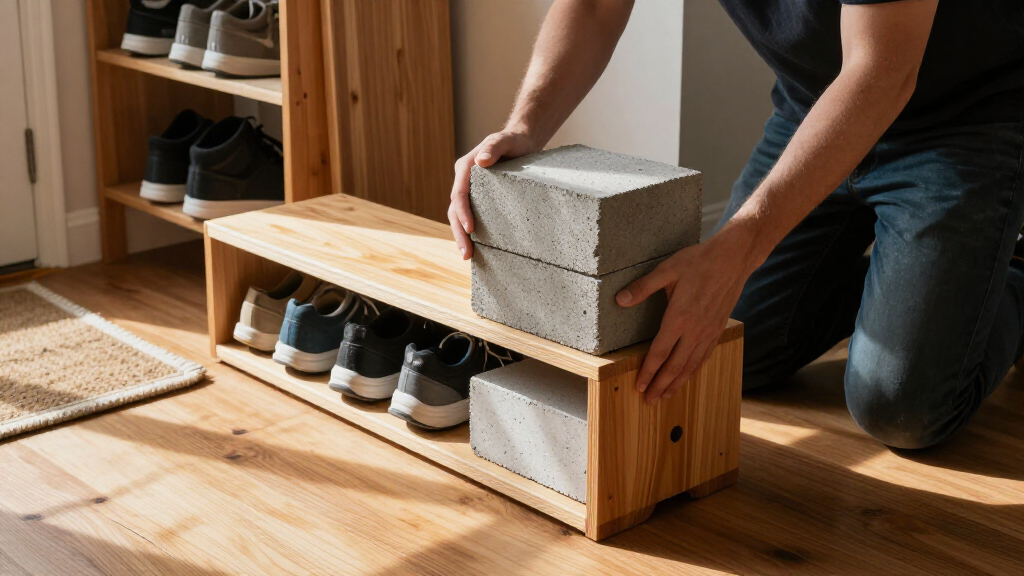
Assembly begins with a plywood board on the floor. Two blocks are placed at each end, with their openings facing forward, followed by another board above them. The remaining blocks sit at the ends of that board with their openings facing inward; the last plywood piece forms the top. The report says construction adhesive is optional and describes the shelf as sturdy without it, but it provides no measurements from a load test. The finished openings can also hold small items.
A Low-Cost Alternative to Metal Racks
The design repurposes common building materials into entryway or bedroom shoe storage, allowing readers to adapt the shelf’s length and finish to their space. It also provides three surfaces that can serve different purposes: shoes can go on the lower levels, while the top can hold decor or everyday items.
Its appeal is partly practical: the source describes a straightforward build and says the blocks are relatively inexpensive. But the listed price is a report-time example, not a current quote, and the materials still require handling, preparation and enough room for a substantial shelf. Readers should measure the intended location and check that the finished unit sits level and stable before putting belongings on it.
The project is a storage idea, not a tested furniture product. Hunker does not report a maximum load, anchoring instructions, or whether the shelf has been assessed for use around children or pets. Those gaps matter when deciding where to place it and how heavily to load it.
As an affiliate, we earn on qualifying purchases.
How the Three-Tier Design Works
The Hunker report presents the shelf as an alternative for people who want to organize shoes near a front door or in a bedroom. Its structure relies on plywood boards as shelves and blocks as supports at each end. The openings in the blocks remain visible and can be used for small storage, rather than being treated only as part of the support structure.
The instructions also offer ways to change the appearance or conceal footwear. Baskets or bins can sit on the boards, and labels can distinguish household members’ storage. Another option described in the report is to keep shoes on the bottom level and add a tension rod and short curtain. These are suggested variations; the source does not give specific dimensions for baskets, curtains or rods.
“The project calls for six 8-by-8-by-16-inch concrete blocks and three matching plywood pieces.”
— Hunker, reporting on a DIY shared by BEHR Paint
Load Limits and Stability Are Unspecified
The source does not say how much weight the finished shelf can safely carry, whether the blocks and boards should be fastened together, or what plywood thickness is appropriate. It also does not provide a stability test or guidance on anchoring the unit. The description that the shelf should be sturdy is the report’s characterization, not a published performance rating.
Other practical details are also left open, including the exact board length, the floor space required, and how the construction should be adapted for uneven floors. The report’s example store prices may no longer apply. Readers should not treat the build instructions as proof that every version will be safe under every load or in every home.
Measure, Build and Check the Shelf
The supplied report does not identify a scheduled product launch, follow-up test or other next milestone; this is a DIY proposal rather than a developing news event. Anyone considering the build can start by measuring the intended area, selecting boards that fit, and confirming the current cost and availability of materials.
After assembly, check that the shelf is level and stable before adding shoes or other items, and reassess it if it shifts. Because the report does not specify a load limit, avoid assuming a safe capacity from the materials list alone. Any questions about fastening or safe placement should be resolved before the shelf is put into regular use.
Key Questions
What materials does the shoe shelf require?
The plan uses six 8-by-8-by-16-inch concrete blocks and three plywood boards that are 16 inches wide. The report leaves the board length flexible and suggests pieces several feet long.
Is construction adhesive required?
No. Hunker’s instructions describe adhesive as optional and say the shelf should be sturdy without it. The report does not provide a load test, so that statement is not a rated safety guarantee.
Can the shelf hide shoes?
Yes. The report suggests putting baskets or bins on the wooden levels, or using a tension rod and short curtain to cover shoes stored on the bottom level.
How much weight can the shelf hold?
The source does not publish a maximum load or a tested capacity. It also does not specify plywood thickness or fastening requirements, so readers should not infer a safe weight limit from the instructions.
How much does the project cost?
Hunker reported that the specified blocks sold for less than $2 each at Home Depot at the time of its article. That is not a current price quote, and the source does not give a total project cost for plywood, paint, stain or optional adhesive.
Source: rss
Fall Picks
fall essentials
As an affiliate, we earn on qualifying purchases.