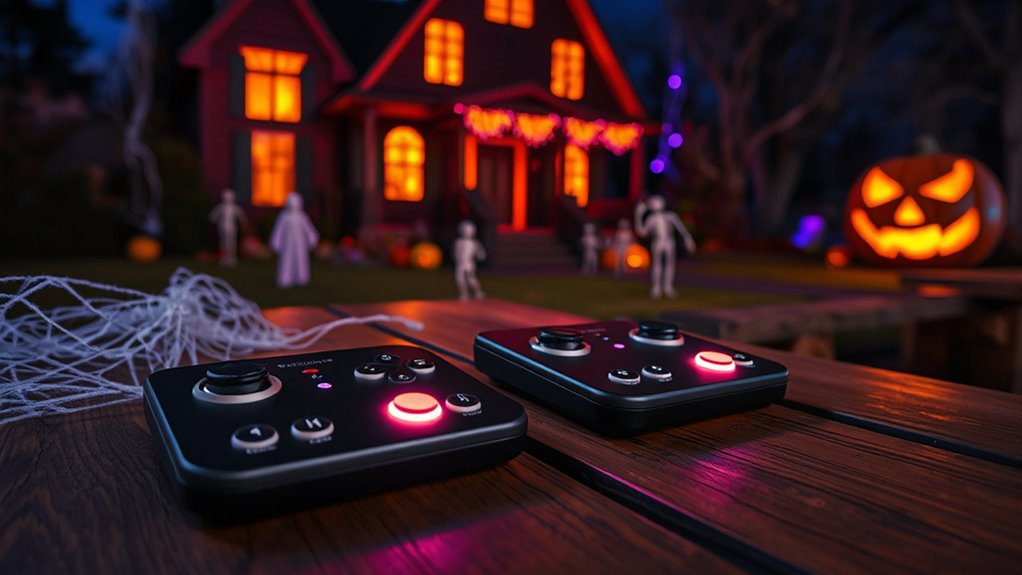

For wireless show control for Halloween displays, my best overall pick is the JERRAY Wireless DMX512 Kit with 1 Transmitter and 3 Receivers, since its multi-receiver layout can serve several compatible fixtures from one transmitter. The Donner Wireless DMX512 Set is a straightforward alternative for a basic transmitter-and-receiver link, while the Spirit Halloween Multi-Prop Remote suits shoppers controlling compatible Spirit props rather than a DMX lighting rig. The main tradeoff is between broad DMX flexibility and simpler, device-specific control; wireless links also need a clear setup plan and a wired fallback for show-critical effects. Read on for the full comparison, including where receiver count, display controls, and intended compatibility change the best choice.

Get decor and gifts delivered free with Prime
- Fast, free delivery on millions of items
- Prime Video, Amazon Music and more included
- Member-only deals all year
Complete the kit


Key Takeaways
Receiver count changes the setup math: the JERRAY kit with three receivers and CroSpin’s three-receiver set can serve more wireless endpoints from one transmitter than the single-receiver options.
DMX gear is not a universal prop remote: the Spirit Halloween Multi-Prop Remote is a separate, device-specific control path; check prop compatibility before treating it as part of a DMX system.
Display and channel controls favor hands-on setup: LCD-equipped choices such as the JERRAY controller and the 16-group ID model can make linking and configuration clearer, but they still require DMX familiarity.
A transmitter-and-receiver pair keeps a small show simple: Donner and Lixada are more direct options when the goal is a basic wireless DMX connection rather than distributing signal to several fixtures.
Feature labels do not replace compatibility checks: verify channel behavior, connectors, receiver pairing, and the control protocol of every fixture before choosing among these nine products.
| CaalLogt DMX512 Controller 2.4G Wireless Transmitter Receiver with LCD Display |  | Best for Multi-Zone Control | Brand: CaalLogt | Protocol: DMX512 | Channels: 126 | VIEW ON AMAZON | See Our Full Breakdown |
| Spirit Halloween Multi-Prop Remote, Multicolor |  | Best for Simple Animatronic Triggers | Model number: 01405976 | Product dimensions: 1 x 1 x 1 inches | Item weight: 10.2 ounces | VIEW ON AMAZON | See Our Full Breakdown |
| Donner Wireless DMX512 Transmitter and Receiver Set |  | Best Value DMX Pair | Model: TS-WDMX01A | Set includes: 1 transmitter and 1 receiver | Protocol: DMX512 | VIEW ON AMAZON | See Our Full Breakdown |
| JERRAY DMX512 Wireless Controller with LCD Display |  | Best for Repeater Flexibility | Wireless protocol: DMX512, 2.4 GHz | Functions: Transmitter, receiver, repeater | Display: LCD | VIEW ON AMAZON | See Our Full Breakdown |
| JERRAY Wireless DMX512 Kit with 1 Transmitter and 3 Receivers |  | Best for Multi-Location Lighting | Model: DMX512 Wireless Receiver/Transmitter | Wireless frequency: 2.4 GHz ISM | Frequency hopping: 126 channels | VIEW ON AMAZON | See Our Full Breakdown |
| Lixada 2.4G Wireless DMX512 Transmitter and Receiver |  | Best for Channel and Group Flexibility | Brand: Lixada | Protocol: DMX512 | Wireless frequency: 2.4 GHz | VIEW ON AMAZON | See Our Full Breakdown |
| JERRAY 3-Piece Wireless DMX512 Lighting Controller Set with 1 Transmitter and 2 Receivers | 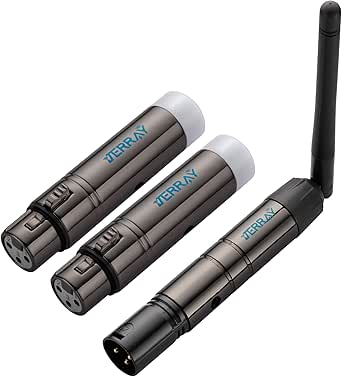 | Best for Two Lighting Zones | Set contents: 1 transmitter, 2 receivers | Wireless frequency: 2.4 GHz ISM | Frequency hopping: 126 channels | VIEW ON AMAZON | See Our Full Breakdown |
| Wireless Mini 512-Channel DMX512 Lighting Controller, 2.4 GHz, Manual & Auto Modes |  | Best for Beginners Running Simple Sequences | Channels: 512 | Wireless frequency: 2.4 GHz | Protocol: DMX512 | VIEW ON AMAZON | See Our Full Breakdown |
| CroSpin Wireless DMX512 Transmitter and 3-Receiver Set with LED Displays |  | Best for Battery-Powered Multi-Point Coverage | Brand: CroSpin | Model: YXE-A2 | Set contents: 1 transmitter and 3 receivers | VIEW ON AMAZON | See Our Full Breakdown |
More Details on Our Top Picks
CaalLogt DMX512 Controller 2.4G Wireless Transmitter Receiver with LCD Display
For a Halloween display with several DMX lighting zones, this CaalLogt transceiver stands out for its 16 ID groups and four adjustable power levels. Those controls can help separate nearby wireless networks and adapt output to different venue sizes, while support for 126 channels suits more involved lighting rigs. Compared with the Donner Wireless DMX512 Set, which offers seven ID groups, CaalLogt gives a multi-controller setup more group options. That advantage matters most when several operators or installations share a crowded space; a simple yard display may never use it. The tradeoff is that the supplied details do not specify a range, and manual frequency adjustment may still be needed in busy RF conditions. I would choose it for flexible DMX lighting control, not as a direct remote for ordinary animatronics.
Pros:- Sixteen ID groups offer more separation options than the seven-group Donner set
- Four adjustable power levels let users adapt wireless output to the setup
- Supports up to 126 DMX channels for complex lighting arrangements
- Frequency hopping is designed to reduce interference
Cons:- Manual frequency adjustment may be needed in crowded RF environments
- No operating range is specified, making placement planning harder
- Requires compatible DMX lighting equipment rather than serving as a universal prop remote
Best for: Halloween event organizers running multiple DMX lighting zones near other wireless lighting networks
Not ideal for: Home decorators who want a one-button trigger for non-DMX animatronics or need a clearly specified operating range
- Brand:CaalLogt
- Protocol:DMX512
- Channels:126
- ID groups:16
- Power levels:4 adjustable levels
- Frequency hopping:Enabled
- Item weight:13.4 ounces
- Package dimensions:6.26 x 5.94 x 2.05 inches
Our verdict“Choose this CaalLogt model for a multi-zone DMX Halloween display where its 16 groups matter more than a specified range or simple prop activation.”
Spirit Halloween Multi-Prop Remote, Multicolor
This is the lineup’s clearest choice for triggering Halloween props without building a DMX lighting system. The single-button multi-prop activation is aimed at animatronics, so it is more straightforward for a small haunted entryway than the Donner Wireless DMX512 Set, which needs DMX-compatible gear and powered transmitter and receiver units. That simplicity comes with a narrower job: the product details do not identify DMX control, lighting channels, or a wireless range. Its compact form can make it easy to keep near a prop operator, but the reported limited range may restrict where that operator can stand. Build quality is also described as less robust than higher-end remotes. I would pick it for basic, coordinated prop activation, not for synchronizing a complex lighting show.
Pros:- One button can activate multiple animatronic props
- Compact form is easy to place near the operator
- Does not call for a DMX console or DMX lighting setup in the provided product details
Cons:- Limited range may keep the operator close to the props
- Build quality is described as cheap compared with higher-end remotes
- No DMX channel, ID-group, or range specifications are provided
Best for: Halloween homeowners who want one simple control to activate multiple compatible animatronic props
Not ideal for: Display builders seeking DMX lighting control, detailed wireless configuration, or a documented long operating range
- Model number:01405976
- Product dimensions:1 x 1 x 1 inches
- Item weight:10.2 ounces
- Recommended age:14 years and up
- Construction:Plastic and metal
- Color:Multicolor
- Stated control function:Single-button activation of multiple animatronic props
Our verdict“Pick this remote for straightforward multi-prop activation, but choose a DMX wireless system such as Donner for lighting-show control.”
Donner Wireless DMX512 Transmitter and Receiver Set
The Donner set keeps the wireless DMX setup focused: one transmitter and one receiver carry console data to compatible lighting equipment, with 126 automatically hopping channels and seven selectable ID groups. For a Halloween display with one remote lighting zone, that pairing is a more direct fit than the JERRAY kit with three receivers, which supplies more endpoints for a wider rig. Its metal construction also distinguishes it from a simple plastic prop remote such as the Spirit Halloween Multi-Prop Remote, though these products serve different jobs. The main compromise is practical rather than technical: the Donner units require power adapters and have no built-in batteries, so each placement needs power access. Compatibility is also limited to devices marked DMX512. I’d shortlist it for a compact, fixed lighting run, not a battery-powered or multi-destination setup.
Pros:- Transmits DMX512 data in real time
- Automatic frequency hopping across 126 channels is designed to resist interference
- Seven selectable ID groups support separation from other compatible setups
- Metal units suit a fixed installation better than a lightweight handheld prop remote
Cons:- Power adapters are required, with no built-in batteries
- The set includes only one receiver, fewer than the JERRAY three-receiver kit
- Works only with DMX512-compatible equipment
Best for: Halloween display builders with one DMX console and one fixed lighting zone who can supply power at both ends
Not ideal for: Operators who need multiple receivers, battery-powered placement, or control of non-DMX animatronics
- Model:TS-WDMX01A
- Set includes:1 transmitter and 1 receiver
- Protocol:DMX512
- Frequency:2.4 GHz ISM
- Channels:126 with automatic frequency hopping
- ID groups:7
- Material:Metal
- Power:Requires power adapter; no built-in battery
- Weight:10.5 ounces
Our verdict“Choose Donner for a powered, single-zone DMX lighting link; select a multi-receiver kit if one transmitter must reach several lighting locations.”
JERRAY DMX512 Wireless Controller with LCD Display
The JERRAY controller’s defining feature is its transmitter, receiver, and repeater functionality, paired with an LCD that reports operating status. For a Halloween display where a wireless signal path may need another hop, that flexibility gives it a different role from the straightforward Donner transmitter-and-receiver pair. Its DMX input and output ports also make it easier to place within a compatible lighting chain, while the metal housing and mounting brackets suit a more permanent installation. The tradeoff is that this is a powered DMX component, not a handheld prop trigger: it needs a DC 5V supply of at least 300mA and only works with DMX-enabled equipment. Unlike the JERRAY kit with three receivers, the supplied details do not promise multiple receiver endpoints. I’d favor it when status visibility and repeater use matter more than receiver count.
Pros:- Can function as transmitter, receiver, or repeater
- LCD displays transmit, receive, and power status
- DMX input and output ports support placement in a compatible lighting chain
- Metal housing includes mounting brackets
Cons:- Requires a DC 5V power source rated at 300mA minimum
- Compatibility is limited to DMX-enabled lighting equipment
- Provided details do not specify a multi-receiver kit or operating range
Best for: DMX display operators who want visible status and repeater functionality in a mounted, powered lighting setup
Not ideal for: Decorators seeking a battery-operated remote, a simple animatronic trigger, or a kit with several included receivers
- Wireless protocol:DMX512, 2.4 GHz
- Functions:Transmitter, receiver, repeater
- Display:LCD
- Power input:DC 5V, 300mA minimum
- Ports:DMX input and output
- Housing:Metal with mounting brackets
- Item weight:13.7 ounces
- Package dimensions:6.54 x 6.26 x 2.32 inches
- Model number:T/R Disp Staion
Our verdict“Choose this JERRAY controller when LCD status and repeater use are more useful to your DMX layout than the Donner set’s simpler transmitter-receiver pairing.”
JERRAY Wireless DMX512 Kit with 1 Transmitter and 3 Receivers
When one Halloween lighting console needs to reach several fixture locations, this JERRAY kit has the clearest hardware advantage: it includes one transmitter, three receivers, and four power adapters. That makes it a better fit for distributing DMX lighting data around a yard or haunted attraction than the Donner set, which includes just one receiver. The kit uses 2.4 GHz frequency hopping across 126 channels and offers seven independent groups; its stated line-of-sight range is up to 400 meters, though actual placement conditions may affect performance. The cost of that multi-point reach is a need for power outlets at every unit, since there are no batteries. It also carries DMX lighting data only, not audio or animatronic trigger commands. I’d choose it for several powered lighting zones, rather than a portable or all-in-one show controller.
Pros:- Three receivers let one transmitter serve multiple lighting locations
- Four power adapters are included for the complete transmitter-receiver kit
- 126-channel frequency hopping is designed to reduce interference
- Seven independent groups support separate compatible lighting rigs
Cons:- All units require AC adapters and have no batteries
- Transmits DMX lighting data only, not audio
- The stated 400-meter distance is line of sight, so obstacles and site conditions can limit placement
Best for: Halloween display builders distributing DMX lighting from one console to three powered fixture locations
Not ideal for: Users without outlets near each receiver, or anyone expecting wireless audio or direct animatronic control
- Model:DMX512 Wireless Receiver/Transmitter
- Wireless frequency:2.4 GHz ISM
- Frequency hopping:126 channels
- Communication distance:Up to 400 m (1300 ft), line of sight
- Groups:7 independent groups
- Connectors:3-pin XLR male and female
- Kit contents:1 transmitter, 3 receivers, 4 power adapters
- Power:AC adapters; no batteries
Our verdict“Pick this JERRAY kit when a single DMX source must reach several powered lighting zones; choose a single-receiver set for a simpler installation.”
Lixada 2.4G Wireless DMX512 Transmitter and Receiver
The Lixada is a straightforward wireless link for Halloween displays that already use a DMX console and compatible fixtures. Its 126 frequency channels and 16 ID groups offer more grouping options than the JERRAY 3-Piece Set, which lists seven group IDs; that can help when coordinating separate lighting zones or working around wireless congestion. Four selectable output power levels give operators a way to adjust transmission power to the setup, though the product details do not state a range, so I would not choose it based on coverage across a large yard. Unlike the CroSpin set, it does not specify rechargeable receivers or status displays. It makes most sense for buyers who value channel and group choices over an all-in-one multi-receiver package, but the missing range and accessory details leave more planning to the buyer.
Pros:- 126 frequency channels and 16 ID groups provide flexible options for organizing a setup
- Four selectable output power levels allow adjustment to the installation
- Wireless DMX link removes the cable run between the control point and compatible lights
Cons:- No wireless range is specified, making it hard to plan coverage for a yard
- Package contents and included accessories are not identified
- A single transmitter-and-receiver setup offers less out-of-the-box multi-light coverage than the CroSpin three-receiver kit
Best for: DMX display builders who want many channel and group options for organizing compatible lights and can confirm the needed range and accessories before setup
Not ideal for: Buyers coordinating several distant lighting zones who need a stated range, multiple included receivers, or battery-powered operation
- Brand:Lixada
- Protocol:DMX512
- Wireless frequency:2.4 GHz
- Frequency channels:126
- ID groups:16
- Selectable output power levels:4
- Item weight:13.7 ounces
- Package dimensions:6.1 x 6.02 x 2.05 inches
Our verdict“Choose the Lixada if channel and group flexibility matter more than a published range or a multi-receiver package.”
JERRAY 3-Piece Wireless DMX512 Lighting Controller Set with 1 Transmitter and 2 Receivers
For a Halloween layout with two separated DMX lighting points, the JERRAY 3-Piece set has a practical advantage: one transmitter and two receivers are included, so a buyer can connect two compatible fixtures or lighting zones without adding another receiver. The stated range of up to 1,000 feet is useful as a planning reference, although actual coverage can be lower around walls, structures, and interference. Its 2.4 GHz frequency hopping and 126 channels provide ways to handle crowded wireless conditions, while seven group IDs offer fewer grouping choices than the Lixada. Unlike the CroSpin kit, the JERRAY receivers are not rechargeable and all units need power adapters. That makes it a better fit for locations with accessible outlets than for scattered props where battery operation would simplify placement.
Pros:- Includes two receivers, allowing control of two DMX connection points from one transmitter
- Frequency hopping across 126 channels supports wireless coordination
- Seven group IDs allow separate grouping options
- Power adapters are included for all three units
Cons:- Requires continuous adapter power and is not battery-powered
- The stated 1,000-foot range is not independently verified and may be reduced by obstacles
- Seven group IDs offer fewer grouping choices than the Lixada’s 16
Best for: Halloween decorators running two compatible DMX lighting zones from one control point, with power outlets available at both receiver locations
Not ideal for: Buyers placing receivers far from outlets or needing rechargeable units and visible signal-status displays
- Set contents:1 transmitter, 2 receivers
- Wireless frequency:2.4 GHz ISM
- Frequency hopping:126 channels
- Group IDs:7
- Stated range:Up to 1,000 ft
- Power:Power adapters included; not battery-powered
- Compatibility:DMX512 lighting
Our verdict“Pick this set for two powered DMX locations; choose CroSpin instead if rechargeable receivers matter more than outlet-powered simplicity.”
Wireless Mini 512-Channel DMX512 Lighting Controller, 2.4 GHz, Manual & Auto Modes
This mini controller is the most hands-on option in this group: instead of serving only as a wireless link, it adds manual dimming, auto scene playback, and programmable scenes. For a Halloween display, that can make it easier to build and replay a basic lighting sequence without relying on a more elaborate console. Six banks with eight scenes each give the operator presets to organize, while the one-key blackout is handy when the show needs an immediate lights-out moment. Compared with the Lixada transmitter-and-receiver pair, this unit offers more direct control tools; compared with the JERRAY set, it does not list multiple receivers for distributing signal to separate fixture locations. It also needs an external 9V–12V adapter, so its compact size does not make it a cable-free portable controller.
Pros:- Manual dimming and auto scene loops support both live adjustments and repeatable sequences
- Six banks with eight scenes each provide room to save programmed looks
- One-key blackout offers a quick way to cut the controlled lighting
- Supports both wireless transmission and standard wired DMX512
Cons:- Requires an external 9V–12V DC adapter and has no built-in battery
- The product data does not specify wireless range
- Unlike the JERRAY 3-Piece set, it does not list two included receivers for separate lighting locations
Best for: First-time DMX users who want to program and replay straightforward Halloween lighting scenes from a compact controller
Not ideal for: Operators who need battery-powered control, multiple included wireless receivers, or a documented receiver range
- Channels:512
- Wireless frequency:2.4 GHz
- Protocol:DMX512
- Power supply:External 9V–12V DC adapter
- Programmable scenes:6 banks with 8 scenes each
- Control functions:One-key record, one-key blackout, clear function, 0–100% master dimming
- Operating modes:Manual and auto
Our verdict“Choose this controller if scene programming and simple operation matter more than battery portability or multi-receiver coverage.”
CroSpin Wireless DMX512 Transmitter and 3-Receiver Set with LED Displays
The CroSpin is the most flexible pick here for a yard with several separated DMX fixtures: its three rechargeable receivers can serve multiple connection points, and the stated battery life of up to 20 hours reduces dependence on outdoor outlets. LED displays for frequency and signal strength give operators more feedback during setup than the JERRAY 3-Piece set provides in its listed features. CroSpin also claims up to 600 m of open-area range, but that figure describes unobstructed conditions; walls, scenery, and other obstacles can cut practical coverage. The transmitter still needs external power, so the whole system is not fully untethered. Compared with the Lixada, CroSpin is easier to spread across battery-powered locations, but the Lixada lists more ID groups.
Pros:- Three receivers support multiple DMX fixture locations from one transmitter
- Rechargeable receivers are rated for up to 20 hours of operation
- LED displays show frequency ID and signal strength for setup feedback
- Open-area range is listed as up to 600 m
Cons:- The transmitter requires an external power supply
- Walls and other obstacles can reduce the stated open-area range
- The Lixada offers more ID groups, which may suit setups needing more group separation
Best for: Decorators distributing DMX control to several outdoor fixtures where receiver outlets are scarce and rechargeable operation is useful
Not ideal for: Buyers who need a fully battery-powered transmitter or depend on long-range performance through buildings and dense obstacles
- Brand:CroSpin
- Model:YXE-A2
- Set contents:1 transmitter and 3 receivers
- Connector:3-pin XLR
- Operating frequency:2.4 GHz ISM band
- Frequencies:126
- Frequency bands:20
- Maximum range:600 m (1,968 ft) in open areas
- Receiver battery life:Up to 20 hours
Our verdict“Choose CroSpin for several receiver locations without nearby outlets, provided the transmitter can stay powered and obstacles are manageable.”

How We Picked
I ranked these options by how well their stated control format and included hardware fit common Halloween show layouts. The main criteria were receiver capacity, clarity of pairing and setup controls, DMX usefulness, and whether a product serves general lighting or a narrower prop-control role. A kit with several receivers ranks higher for a display spread across multiple compatible fixtures; a simple pair can be a better fit when the show needs only one wireless link.
I also weighed setup demands and the limits implied by each product’s description. LCD screens, group coding, and manual or automatic modes can help with configuration, but they do not establish compatibility with every light or prop. Because the listed products do not provide enough comparable detail to claim range, reliability, or weather resistance, I avoid ranking them on those claims. The order favors flexible, clearly described multi-endpoint DMX kits, then simpler pairs and specialized or compact choices.
Factors to Consider When Choosing Wireless Show Control For Halloween Displays
Before choosing a wireless controller, map the show’s signal path: what sends DMX, which fixtures receive it, and which effects use their own control system. This planning step often matters more than a feature list because wireless equipment only helps when the devices speak compatible control languages.
Match the Control Protocol to Each Prop
Start by sorting every device into DMX-controlled lighting, proprietary prop control, or standalone operation. A wireless DMX transmitter and receiver move DMX data; they do not automatically replace a prop’s included remote or translate one protocol into another. A common mistake is buying a DMX kit for a fogger, animatronic, or light that only accepts a dedicated controller. Check the device manual for its input type, connector, and channel requirements before buying. If the display mixes systems, plan separate control paths and decide whether one operator can manage them during the show.
Count Receivers by Physical Location
Count the separate locations that need a wireless DMX endpoint, not just the number of fixtures. Several lights may share a wired DMX chain at one location, while fixtures on opposite sides of a yard may need separate receivers. Bundled receiver counts can reduce extra hardware, but only if each receiver can pair and operate as your layout requires. Avoid assuming that a multi-receiver kit means every fixture gets an independent universe or independent control; confirm its operating design in the product documentation. Leave room in the plan for a spare endpoint if a late addition would otherwise require a new signal run.
Plan Channels and Fixture Addressing
DMX systems use channel addresses, and a fixture’s channel footprint affects what else can share a line. Before setup, list each fixture’s channel mode and starting address, then check that the controller and wireless link support the required data arrangement. Display screens and group IDs can make pairing easier to follow, but they do not assign every fixture correctly for you. A frequent error is treating a wireless link as a substitute for addressing and signal planning. Keep a simple channel map near the controller so troubleshooting does not depend on memory in the middle of a show.
Test Radio Performance at the Actual Site
Wireless performance can change around walls, metal structures, trees, and competing radio devices, so published frequency alone cannot predict how a Halloween yard will behave. Test the transmitter and receivers in their planned positions, with the full lighting load active, before show night. Keep antennas clear of metal enclosures where the product design allows, and avoid hiding receivers inside sealed decorative pieces without checking signal behavior. If a missed cue would spoil a major effect, retain a wired route or a manual fallback. Do not choose a system based only on a claimed range measured under different conditions.
Choose Controls You Can Operate Under Pressure
On a busy event night, readable status indicators and an understandable pairing process can matter more than extra modes. LCD controls and group coding may help an operator identify a link, while a compact controller may be easier to place but less convenient to configure. Decide who will run the show and whether that person needs direct access to the controller or can trigger cues from another system. Practice power-up, pairing, and recovery steps before guests arrive. For a beginner, the simplest compatible setup is usually safer than a feature-rich unit whose operation remains unfamiliar.
Treat Outdoor Placement as a Separate Requirement
Wireless does not mean weatherproof. Transmitters, receivers, power supplies, and connectors may need protected placement even when the lights themselves are rated for outdoor use. Check each component’s environmental rating rather than assuming the whole setup can sit outside overnight. Use suitable enclosures and cable routing without blocking antennas or trapping heat, and keep connections away from water and foot traffic. If the product listing does not clearly state outdoor suitability, plan to shelter it or choose equipment with documentation that matches the installation.
Frequently Asked Questions
Can I use a wireless DMX kit with any Halloween prop?
No. A wireless DMX kit carries DMX control data between compatible equipment; it does not make a proprietary prop remote-compatible with DMX. Check the prop manual for a DMX input, supported channel modes, and any required adapter or controller. The Spirit Halloween Multi-Prop Remote is a distinct option for compatible Spirit props, not a general DMX transmitter. If a prop has no DMX input, plan to control it through its intended system.
How many receivers do I need for a yard display?
Count the separate wireless DMX endpoints needed at the locations where fixtures cannot share a local wired DMX chain. A cluster of lights together may use one receiver and a short cable run, while distant groups may need separate receivers. The three-receiver kits in this roundup can suit spread-out layouts, but confirm how their receivers pair and whether the arrangement matches your controller. Draw the layout before purchasing; counting fixtures alone can lead to buying too few or more hardware than the setup needs.
Will wireless DMX work reliably through walls or around the house?
It may, but walls, metal, foliage, and nearby radio traffic can affect the signal, so no general range claim guarantees performance at your site. Test the equipment in its intended positions with the lights running and the house setup active. Keep receiver antennas unobstructed where possible, and consider a wired connection for any cue that cannot be missed. A layout that works in an open driveway may behave differently through a garage wall or behind a metal prop.
Should I buy a multi-receiver kit or a basic transmitter-and-receiver pair?
Choose a multi-receiver kit when the show needs wireless DMX at several separated locations and the kit’s pairing scheme suits that layout. A basic pair is simpler when one receiver can feed a local chain of compatible fixtures. More receivers add flexibility but also create more units to power, place, label, and troubleshoot. Compare the physical signal plan first, then select the smallest kit that covers the required endpoints with room for practical wiring.
What should I verify before using a controller outdoors on Halloween night?
Check the environmental rating for every transmitter, receiver, power supply, and connector; outdoor-rated lights do not make the control gear weatherproof. Confirm power requirements, connector types, channel needs, and pairing steps before installation. Test the full setup in its final positions and keep sensitive electronics sheltered without blocking the radio path or trapping heat. Have a recovery plan, such as a wired DMX run or manual control, for the effects that matter most if a link drops.
Conclusion
For most multi-fixture DMX displays, my best overall choice is the JERRAY Wireless DMX512 Kit with 1 Transmitter and 3 Receivers, because its included receiver count suits a spread-out setup. The best value in practical terms is the Donner Wireless DMX512 Transmitter and Receiver Set for buyers who need a straightforward single link; the Lixada pair is another simple option to compare. For beginners, I would favor the most direct compatible transmitter-and-receiver setup and skip feature-heavy controls until the channel plan is clear. The best premium-style fit for broader layouts is CroSpin’s three-receiver set, while JERRAY’s three-receiver kit is a strong alternative when its listed controls better match the installation. For specific Spirit Halloween props, choose the Multi-Prop Remote only after confirming compatibility. In every case, match the protocol, receiver count, and outdoor placement plan to the actual display before buying.
Fall Picks
fall essentials
As an affiliate, we earn on qualifying purchases.