

Fog and haze may seem similar, but they’re quite different in impact. Fog forms when warm, moist air cools rapidly, creating a dense, white/gray cloud that reduces visibility to just a few meters. Haze, on the other hand, is caused by tiny particles like dust or pollution scattering sunlight, giving the atmosphere a light tint and allowing you to see farther, but with less detail. Knowing these differences helps you better prepare your setup—stay tuned to learn more.
Key Takeaways
- Fog is a dense cloud at ground level, significantly reducing visibility, unlike haze, which causes mild blurring with better visibility.
- Fog forms from cooled, moist air creating water droplets; haze results from airborne particles like dust or pollution.
- Fog decreases color contrast and obscures details, while haze maintains some contrast but distorts distance perception.
- Fog’s opacity makes objects hard to distinguish, requiring safety measures like fog lights; haze demands caution but allows farther sight.
- Understanding these differences helps tailor safety, navigation, and activity adjustments in foggy or hazy conditions.
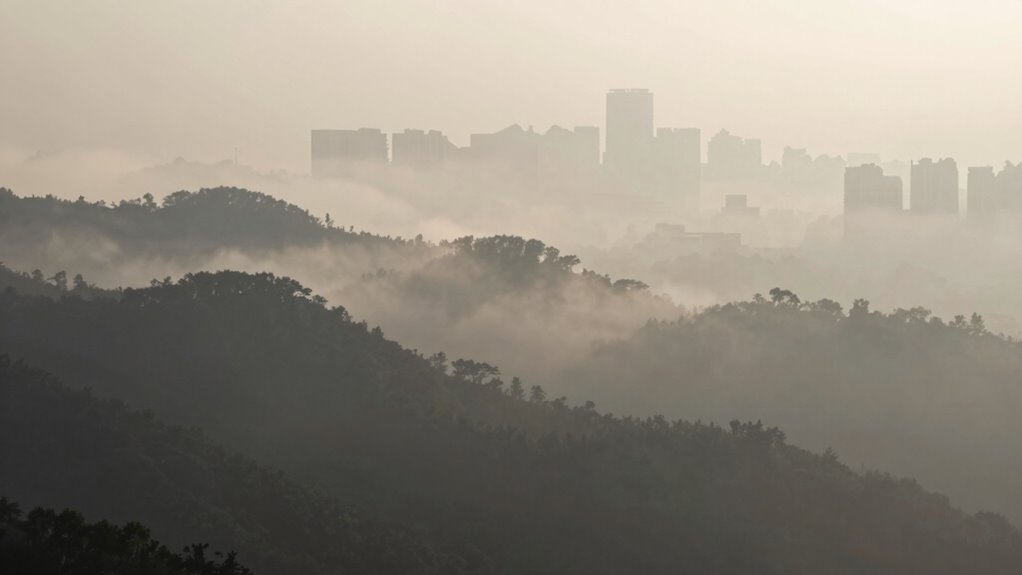
Fog and haze are common atmospheric conditions that can substantially impact visibility and safety, but they differ in their formation and appearance. When you’re trying to navigate through uncertain weather, understanding these differences can make all the difference. One key aspect to consider is how each affects color contrast and visibility impact. These factors are vital whether you’re driving, flying, or simply trying to see clearly outdoors. A notable difference is that fog is essentially a thick cloud at ground level, formed when warm, moist air cools down rapidly, causing water vapor to condense into tiny droplets that hang in the air. This results in a dense, white or grayish blanket that greatly reduces visibility. Because fog tends to be so opaque, it drastically diminishes your ability to distinguish objects from their background, making everything look muted and washed out. The reduced color contrast in fog means that objects are less distinct, and details blend into the background. This can pose serious safety risks, especially when you’re on the road or operating machinery. The visibility impact of fog is profound—you might find yourself unable to see more than a few meters ahead, which demands extra caution and slower speeds. In contrast, haze forms when tiny particles like dust, smoke, or pollution scatter sunlight, creating a light, often yellowish or brownish tint in the atmosphere. It’s less dense than fog, so it doesn’t block your view entirely but causes a softer, more diffuse visibility. The particle matter in haze scatters light, which can make distant objects appear blurry or faded. Understanding the atmospheric conditions that lead to haze helps you recognize the importance of air quality when assessing visibility conditions. The color contrast in haze remains somewhat intact, but the overall scene appears washed out or muted. While haze might not obscure objects completely, it still hampers your ability to perceive fine details and can distort distance perception. The visibility impact of haze is generally less severe than fog, but it can still be a significant issue—especially in urban areas or regions with high pollution levels. Knowing these differences helps you adapt your approach to each condition. With fog, you need to be hyper-aware of your reduced visibility and adjust accordingly, perhaps by using fog lights or slowing down. With haze, you might need to rely more on navigation aids and be cautious about your surroundings, even if you can see farther than in fog. Both conditions challenge your perception, but understanding their unique effects on color contrast and visibility impact empowers you to respond better and stay safer.
As an affiliate, we earn on qualifying purchases.
Frequently Asked Questions
How Do Fog and Haze Affect Visibility Differently?
Fog markedly reduces visibility because it’s made of tiny water droplets that scatter light, lowering visual clarity and affecting your air quality. Haze, on the other hand, involves particles like pollution or dust, which cause a lighter, more diffuse reduction in visibility. While both impact your sight, fog creates a dense curtain that’s harder to see through, whereas haze produces a softer, more widespread dulling effect on your environment.
What Weather Conditions Cause Fog Versus Haze Formation?
You’ll see fog form during high humidity, with moist air cooling overnight, especially in calm, cool conditions, often linked to poor air quality. Haze, on the other hand, results from climate variation and pollution, occurring in dry, warm weather with less moisture. Changes in temperature, wind, and air quality considerably influence whether fog or haze develops, shaping visibility and overall environmental conditions.
Which Is More Harmful to Respiratory Health: Fog or Haze?
Haze is generally more harmful to your respiratory health than fog because it contains higher levels of pollutants like particulate matter and ground-level ozone, which degrade air quality. While fog is mostly water vapor, haze’s environmental effects include lung irritation and increased respiratory issues, especially for vulnerable populations. Don’t dismiss fog’s health risks, but be aware that sustained exposure to haze can considerably impact your lungs and overall well-being.
How Do Fog and Haze Impact Outdoor Photography?
Fog and haze both considerably impact your outdoor photography by altering lighting conditions. Fog creates a diffused, soft light that reduces contrast, making your photos look dreamy but less sharp. Haze filters light unevenly, adding a bluish tint and reducing visibility. Adjust your camera settings accordingly—use lower ISO, wider aperture for fog, and consider a polarizer for haze. These tweaks help you capture clearer, more balanced images despite challenging conditions.
Can Fog or Haze Be Completely Removed From the Air?
You can’t completely remove fog or haze from the air, but air purification systems can help improve visibility by filtering out particles that cause haze. These devices can reduce airborne pollutants, making the air clearer and enhancing your outdoor experience. While they won’t eliminate fog or haze entirely, using air purifiers combined with other measures can substantially improve visibility and create a more comfortable environment for you.
Conclusion
Now that you see the subtle dance between fog and haze, remember it’s like traversing a shadowed forest versus a smoky room—each shapes your journey differently. Understanding these conditions is your compass, guiding your choices and keeping you safe. When you recognize the fog’s gentle embrace or the haze’s smoky veil, you’re not just adjusting your setup—you’re mastering the art of reading nature’s whispers. Embrace this knowledge, and let it illuminate your path through the unseen.