TL;DR

Get decor and gifts delivered free — and shop member deals
- Fast, free delivery on millions of items
- Access to Prime Big Deal Days deals on October 6–7
- Prime Video, Amazon Music and more included
Halloween decorative string lights come in six main types, from classic incandescent minis to smart app-controlled LEDs. LEDs use 75–80% less energy, run cooler near flammable decorations, and cost $8–15 for basic sets. Match the strand to its location: only UL-listed, outdoor-rated lights belong on porches and shrubs, and you should never connect more than the manufacturer’s limit — usually 3–5 strands.
The house at the end of Maple Street doesn’t have the biggest decorations. It has purple and orange string lights woven through its shrubs, a warm glow spilling from the windows, and a porch that looks like it was lit by candlelight. That’s the house kids drag their parents to. Lighting does that.
Halloween decorative string lights are the fastest, cheapest way to transform your home for October — faster than carving a pumpkin, cheaper than an inflatable skeleton. But buying them blind leads to dead strands, tripped breakers, and lights that look great in the box and feeble on your house.
Here’s what you need to know: the key aspects to choosing well, the types worth your money, how to hang them without wrecking your siding, and the safety rules that keep your October spooky instead of smoky.
Buy LED: they use 75–80% less energy than incandescent minis, last longer, and stay cool near paper and fabric decorations.
Only UL-listed, outdoor-rated strands (IP44 or higher) go outside — indoor strands in rain means dead lights and tripped GFCI outlets.
Never connect more strands than the box states, typically 3–5 maximum, and always plug outdoor lights into a GFCI outlet.
Hang with Command hooks, gutter clips, and zip ties — never nails or staples — and add a $10 timer so lights never run unattended.
Stick to two main colors (purple plus orange is the classic base) and layer lights with one or two other elements for depth instead of piling on more.
The 6 Types of Halloween Lights (and Where Each One Shines)
Halloween decorative string lights fall into six main types: classic incandescent minis, LED string lights, novelty shape lights, fairy/micro lights, net and curtain lights, and motion-activated or smart lights. Each type has a job it does better than the others, and matching the type to the location is what separates a polished display from a messy one [1].
Classic incandescent mini lights give you that traditional warm glow — soft, amber, nostalgic. They’re cheap upfront but they run hot and burn through energy. LED string lights cost a few dollars more per strand and pay you back: cooler to the touch, far longer lifespan, and dramatically cheaper to run.
Then come the fun ones. Novelty shape lights — tiny pumpkins, ghosts, skulls, bats, witch hats, even eyeballs — turn a strand into a decoration itself. Fairy lights on thin copper wire disappear inside mason jars, wreaths, and glass pumpkins. Net lights drape over a bush in thirty seconds flat. Smart lights let you change your whole color scheme from the couch mid-trick-or-treat.
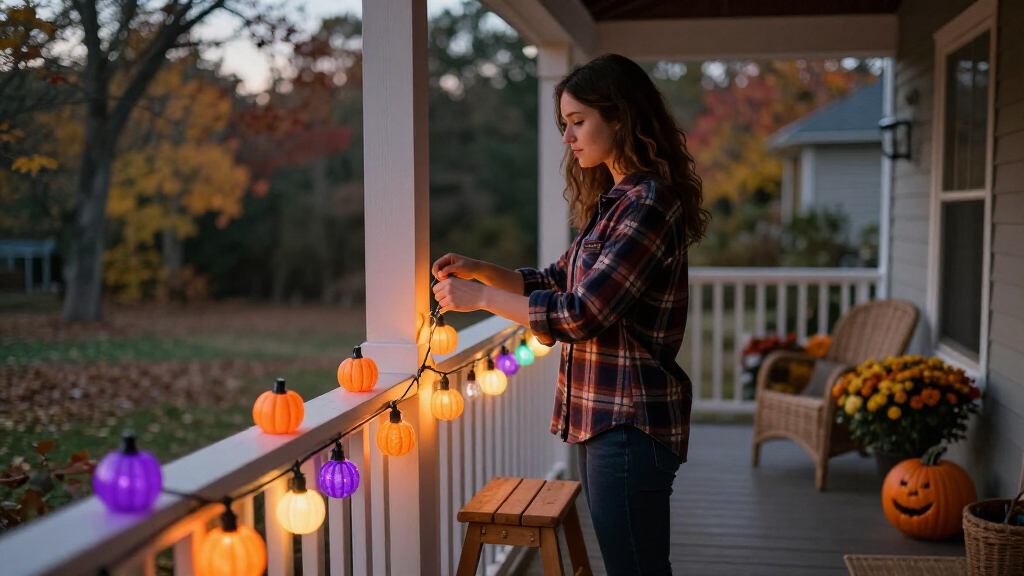
Picture it in practice: a front porch might use pumpkin-shaped novelty lights along the railing for the kids, purple LEDs woven through the boxwoods, and a strand of copper fairy lights glowing inside a glass pumpkin on the steps — three types, three jobs, one cohesive look. Indoors, fairy lights stuffed into a mason jar make a centerpiece that costs about ten dollars total.
| Type | Best For | Typical Price |
|---|---|---|
| Incandescent minis | Warm, nostalgic indoor glow | $5–12 per strand |
| LED string lights | Bushes, railings, long-running displays | $8–15 per strand |
| Novelty shape lights | Kid appeal, mantels, party spaces | $12–25 per strand |
| Net/curtain lights | Shrubs, fences, window backdrops | $15–30 |
| Smart/app-controlled | Full displays, color scenes | $25–50+ |
Why LED Lights Win October: The Math That Changes Your Mind
LED string lights are worth the extra cost because they use roughly 75–80% less energy than classic incandescent mini lights and last many times longer. That’s not marketing — it’s the single biggest shift in the holiday lighting market, and it’s why retailers now stock LED-dominant Halloween sections [1].
Think of incandescent bulbs as tiny space heaters that happen to glow. About 90% of the electricity they consume becomes heat, not light. LEDs flip that ratio — almost everything goes to light. Run a display of eight strands every October evening and the difference shows up on your power bill.
Put real numbers on it: a typical incandescent strand draws about 40 watts, while a comparable LED strand draws around 5–8 watts. Eight strands running five hours a night for a month adds up to roughly $5–7 of electricity with incandescent versus about a dollar with LEDs. And those incandescent strands often don’t survive to a second October — one crushed bulb in storage and half the strand goes dark — while LEDs routinely last five seasons or more.
The heat matters as much as the money. Halloween decorations live next to dry cornstalks, paper bats, and fabric cobwebs — exactly the materials you don’t want a hot bulb touching. An LED strand stays cool enough to weave through a fabric wreath without a second thought; an incandescent bulb against a synthetic cobweb for a few nights is a different story.
If you buy one type of light this year, make it LED. The energy savings, lifespan, and lower fire risk together beat the incandescent price advantage within a season or two.
One honest tradeoff: cheaper LEDs can render color a bit harshly — that icy, electric purple instead of a deep grape. It’s the difference between a rich twilight grape and a highlighter slammed on blacklight. Read reviews that mention color quality, or splurge on a mid-range brand for your most visible strands.
Indoor vs. Outdoor: The Rating That Saves Your Lights (and Your Outlet)
Yes, you can use Halloween string lights outdoors — but only strands rated for it. Look for UL-listed products marked “suitable for outdoor use,” often with an IP44 rating or higher. Indoor-only strands have thinner wire and open sockets that rain will destroy, sometimes dangerously [1].
Outdoor-rated lights differ in three concrete ways: sealed sockets, heavier-gauge wiring, and insulation built for freezing nights and October drizzle. That’s why they cost a couple dollars more. Last year my neighbor strung indoor lights across her porch railing — one rainy Tuesday, half the strand died and the GFCI outlet tripped. The outdoor-rated replacement has survived two seasons.
Think of it like shoes: indoor strands are slippers — fine on carpet, ruined in a puddle. Outdoor-rated strands are rain boots, built to take the weather. The rating is printed right on the box tag, usually as a small UL mark with “indoor/outdoor” or “indoor only” beside it.
- Check the box for “UL-listed for outdoor use” or an IP44+ rating
- Plug outdoor lights into a GFCI outlet (the kind with test/reset buttons)
- Keep connections elevated and wrapped — use weatherproof connection boxes
- No outdoor outlet? Solar-powered strands solve that, though they dim after cloudy fall days
Popular workaround for renters and outlet-less homes: hang indoor-rated lights inside windows facing out. You get the glow from the street with zero weather risk.
Hang Them Without Holes: 5 Steps to a Clean Installation
You can hang Halloween lights without damaging siding or walls by using adhesive hooks, gutter clips, and zip ties instead of nails or staples. Follow these five steps and your display goes up in under an hour — and comes down without a spackle bill.
- Inspect before you install. Unroll each strand, check for frayed cords and cracked bulbs, and plug it in. Fix problems at the kitchen table, not on a ladder.
- Map your runs. Measure the railing, eave, or bush before you buy. Nothing worse than a strand that stops three feet short of the corner.
- Clip, don’t nail. Use Command hooks on siding and painted trim, gutter clips along the roofline, and zip ties on railings.
- Respect the connection limit. Most manufacturers cap end-to-end connections at 3–5 strands. It’s printed on the box — read it.
- Add a timer. A $10 outdoor timer runs the display 6–10 PM and shuts it off overnight, saving energy and eliminating unattended lights.
For example, a typical front-porch setup looks like this: gutter clips every 12 inches along the roofline for the roofline strands, a Command hook at each corner of the door frame to frame the entrance in purple light, and black zip ties around each railing post — snipped and gone in November without a mark. Inside windows, a few clear suction cup hooks hold a curtain-light backdrop in under ten minutes.
Keep cords off walkways and tape down anything crossing a path. A tripping hazard in the dark isn’t a Halloween prank — it’s an ER visit.
Color Combos That Actually Look Good Together
The best Halloween light color combinations are purple and orange as the base palette, with green or red added for creepy accents. This pairing works because purple reads “night and magic” while orange reads “pumpkin and fire” — complementary opposites on the color wheel that make each other pop.
Concretely: wrap your boxwoods in purple LEDs, line the walkway with orange stake lights, and the two colors meet at the porch steps looking deliberate instead of random. Swap the purple for green and the same setup suddenly reads “witch’s lair” instead of “classic Halloween.” Add red only in one spot — a wreath, a doorway — and it becomes the unsettling detail people notice second.
Want to stand out from every other house? Try the elegant Halloween look that’s been trending: warm white string lights with subtle orange pumpkin accents. It reads as sophisticated rather than spooky, and it photographs beautifully. Pair it with a Halloween tree — an artificial tree wrapped in orange and purple lights — which has become a genuine seasonal category at retailers like Target and Home Depot [1].
Layering beats volume. One string of lights alone looks thin; string lights plus a projector plus one inflatable creates depth and shadows that make the whole display feel intentional. Three elements, layered well, beat ten elements piled on.
Rule of thumb: pick two main colors maximum, then use one accent color sparingly. More colors doesn’t mean more festive — it means visual noise.
Safety Rules That Keep Spooky From Becoming Scary
The most important Halloween light safety rules are: don’t overload circuits, keep bulbs away from flammable materials, use timers instead of leaving lights on overnight, and inspect every strand before plugging it in. According to fire safety experts, seasonal decorative lights are a known contributor to October home fires when these basics get skipped [1].
Be specific about spacing. Keep lights clear of dry leaves, paper decorations, fabric cobwebs, and cornstalk bundles — especially incandescent strands, which run hot enough to matter. A classic hazard scenario: an incandescent strand zip-tied to a porch post with a cornstalk bundle leaning against it, a paper bat taped a few inches below. Give that setup a windy, dry week and the bulb has been baking the same spot of dried husk every night. Secure cords along walls and railings so nothing dangles across stairs or a sidewalk.
- Never exceed the manufacturer’s 3–5 strand connection limit
- Plug outdoor displays into GFCI-protected outlets only
- Replace burned-out bulbs promptly — the circuit works harder when they’re out
- Turn everything off when you leave home or go to bed
One caution: if you’re running a large roofline display or adding new outdoor circuits, that’s licensed-electrician territory. Hardwiring anything new — or working near your panel — isn’t a DIY weekend job.
When the season ends, wind each strand loosely around a piece of cardboard and store it in a plastic bin. Never yank a strand down — that’s how next year’s tangle and broken bulbs are born.
Frequently Asked Questions
Can I use Halloween string lights outdoors?
Yes, but only strands marked “UL-listed” and “suitable for outdoor use,” ideally with an IP44 rating or higher. These have sealed sockets and heavier wiring that shrugs off rain and frost. Indoor-only strands will fail outdoors and can create a shock hazard — always plug into a GFCI outlet.
How many strands can I safely connect together?
Follow the manufacturer’s limit printed on the box — usually 3–5 strands maximum for end-to-end connections. Exceeding it overloads the circuit and creates a fire risk. For bigger displays, run separate extension cords from different outlets instead of chaining.
Are LED Halloween lights really worth the extra cost?
Yes. LEDs use about 75–80% less energy than incandescent strands and last far longer, so the $3–5 price difference pays back within a season or two. They also run cool, which makes them much safer near paper decorations, fabric cobwebs, and dry cornstalks.
Why did half my strand go out, and how do I fix it?
Incandescent strands are wired in series, so one loose or burned-out bulb can kill everything downstream. Use a bulb tester or wiggle each bulb until the section relights, and replace dead bulbs promptly. LED strands usually have shunts that keep the rest lit when one fails.
How do I store string lights so they don’t tangle or break?
Wind each strand loosely around a rectangle of cardboard or a cord reel, secure with a twist tie, and store flat in a plastic bin — never in a drawer as a loose ball. Check each strand for broken bulbs and frayed wire before boxing it, so problems don’t surprise you next October.
Conclusion
If you remember one thing: match the strand to the job. LED for anything that runs long or sits near decorations, outdoor-rated wire for anything that touches weather, and a timer on everything. Do that, and your display costs pennies a night and survives to haunt again next October.
Start with one bush, one railing, or one window. String it well, flip the switch at dusk, and walk across the street to look back. When your house glows like the one kids remember, you’ll know why the lights were worth the hour.
Fall Picks
fall essentials
As an affiliate, we earn on qualifying purchases.