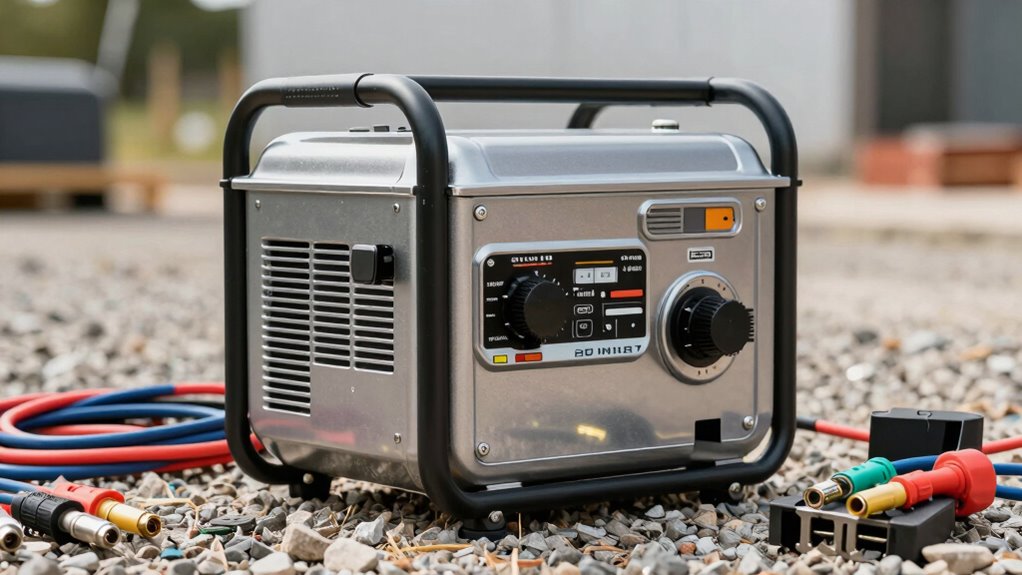

To size your inverter generator accurately, start by listing all your devices and noting their wattage, including surge requirements. Add up these wattages, then multiply the total by 1.2 to 1.25 — this gives you a safe buffer. Choose a generator rated slightly above this number for reliable performance without overloading. Keep in mind, getting this right prevents excess noise and fuel waste, and more tips are just ahead to help you get it perfect.

Get decor and gifts delivered free — and shop member deals
- Fast, free delivery on millions of items
- Access to Prime Big Deal Days deals on October 6–7
- Prime Video, Amazon Music and more included
Key Takeaways
- List all devices’ wattages, including startup surges, to determine total power needs.
- Add a 20-25% safety margin to your total wattage for reliable operation.
- Use the formula: Generator size = Total wattage × 1.2 to 1.25 for accurate sizing.
- Ensure the inverter generator can handle peak surge wattages of appliances.
- Proper sizing improves fuel efficiency, reduces noise, and extends generator lifespan.

Choosing the right inverter generator size is essential to guarantee it meets your power needs without being over or underpowered. When sizing your generator, you want to find a balance that ensures reliable operation while maximizing fuel efficiency. If your generator is too small, it won’t handle your essential devices, causing it to run constantly at full capacity, which wastes fuel and shortens its lifespan. On the other hand, an oversized generator can be inefficient, consuming more fuel than necessary and generating unnecessary noise. To avoid these pitfalls, you need a straightforward way to determine the right size for your needs.
Start by listing all the devices you plan to run simultaneously, noting their wattage requirements. For example, a refrigerator might need around 600 watts, while a laptop only requires about 100 watts. Add these together to find your total continuous power requirement. Then, factor in the startup or surge power needed by some appliances, like refrigerators or power tools, which often require double their running wattage during startup. Once you’ve calculated your total starting and running wattages, choose a generator with a rated wattage comfortably above that total—typically 20-25% higher—to give yourself a buffer.
Calculate total device wattage, including surge needs, then select a generator 20-25% higher for reliable power and efficiency.
Now, consider fuel efficiency, which is crucial for longer use or remote locations. An appropriately sized inverter generator will run more efficiently because it isn’t working at full capacity constantly. This not only saves you money on fuel but also reduces emissions and prolongs the life of your generator. Keep in mind that a generator that’s too large for your needs will consume more fuel than necessary, making it less economical over time. Conversely, a generator that’s just right consumes fuel more efficiently and operates smoothly, reducing wear and tear. Additionally, understanding the power requirements of your devices can help optimize your generator choice. Properly sizing your generator also involves considering load capacity, ensuring it can handle peak demands without overloading. Recognizing the importance of generator efficiency can help you make the best choice for long-term savings and performance.
Ultimately, using a simple formula—adding up your devices’ wattages, including surge wattages, and then selecting a generator rated 20-25% higher—makes sizing straightforward. This ensures your inverter generator provides enough power, runs efficiently, and keeps noise levels manageable. A well-sized generator can also prevent overloading, which could damage your appliances or the generator itself. By applying this quick calculation, you’ll avoid guesswork, save on fuel, and enjoy reliable, quiet power wherever you need it.
As an affiliate, we earn on qualifying purchases.
Frequently Asked Questions
How Do Inverter Generators Compare to Traditional Generators?
You’ll find inverter generators are quieter and more portable than traditional ones, making them ideal for camping or outdoor events. They produce lower noise levels, so you won’t disturb neighbors or fellow campers. Plus, their compact design enhances portability, allowing you to easily carry and store them. Traditional generators tend to be bulkier and louder, which can limit their use in situations where noise and size matter most.
Can Inverter Generator Size Affect Fuel Efficiency?
Yes, inverter generator size can affect fuel efficiency. If you choose a generator that’s too large for your needs, it may consume more fuel unnecessarily, reducing overall fuel consumption. Conversely, sizing it appropriately helps optimize power, ensuring the generator runs efficiently without overworking. Proper sizing enhances fuel efficiency by aligning power output with your demands, leading to better fuel consumption and reliable performance during use.
Is It Better to Oversize or Undersize an Inverter Generator?
You should aim for a generator that matches your load capacity closely, rather than oversizing or undersizing. Oversizing might seem like a safe bet, but it can lead to higher noise levels and wasted fuel, while undersizing risks insufficient power and potential overloads. Finding the right fit guarantees efficient operation, keeps noise levels manageable, and saves fuel, making your experience smoother and more enjoyable—like finding that perfect playlist for a long drive.
How Often Should I Perform Maintenance on My Inverter Generator?
You should perform regular maintenance on your inverter generator every 50-60 hours of use or at least once a year, whichever comes first. Follow a consistent maintenance schedule to keep it running smoothly. Service tips include checking oil levels, inspecting air filters, and testing spark plugs. Staying proactive guarantees your generator remains reliable, efficient, and ready whenever you need it. Regular upkeep prolongs its lifespan and prevents unexpected breakdowns.
Are Inverter Generators Suitable for All Types of Appliances?
Inverter generators are suitable for most appliances, thanks to their excellent appliance compatibility and power stability. They produce clean energy that won’t damage sensitive electronics like laptops or TVs. However, for high-power appliances such as air conditioners or large power tools, check the generator’s wattage capacity first. Overall, inverter generators offer reliable, stable power, making them a smart choice for a wide range of household and outdoor appliances.
Conclusion
By using this quick formula, you’ll accurately size your inverter generator without guesswork. Did you know that properly matched generators can improve fuel efficiency by up to 20%? That means saving money and reducing emissions while ensuring your devices run smoothly. So, don’t leave it to chance—apply this simple calculation and enjoy reliable power whenever you need it. With the right size, you’ll never be left in the dark, making your outdoor adventures or emergency power more dependable.
Fall Picks
fall essentials
As an affiliate, we earn on qualifying purchases.