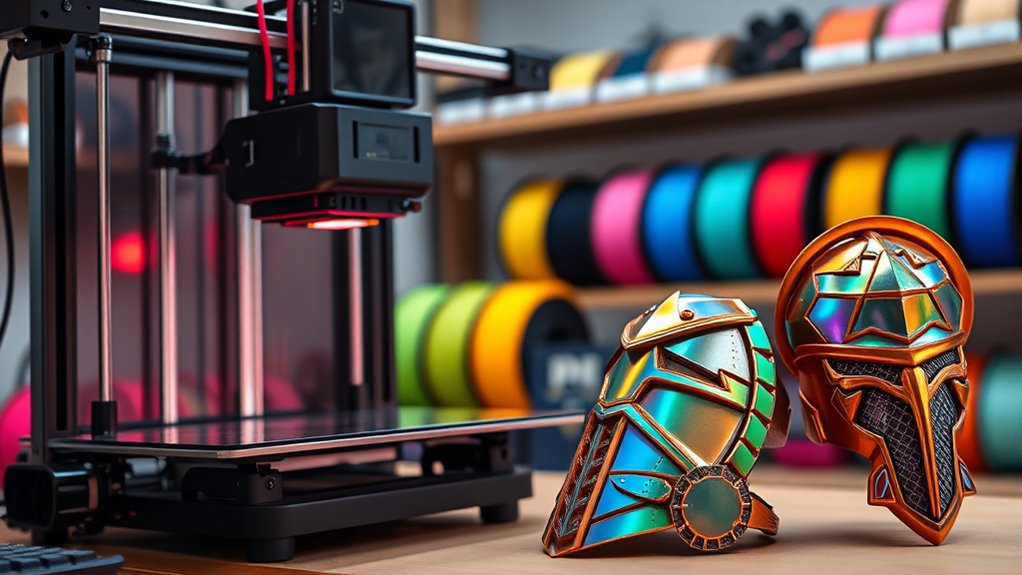

For most cosplay armor projects, Polymaker CosPLA is my best overall pick because its cosplay-oriented formulation prioritizes parts that are easier to finish and wear. Kingroon PLA is a straightforward choice for beginners and large test builds, while ELEGOO PC suits experienced makers who need more heat resistance and toughness. The main tradeoff is between easy printing and sanding, added durability, and decorative finishes that may be harder to paint or repair. No filament removes the need to test fit, reinforce, and finish armor pieces for your printer and climate. Read on for my comparison of all seven options and the factors that matter before you buy.

Get decor and gifts delivered free with Prime
- Fast, free delivery on millions of items
- Prime Video, Amazon Music and more included
- Member-only deals all year
Complete the kit


Key Takeaways
- CosPLA is the most cosplay-focused option: it is the clearest starting point for armor parts where finishing and wearability matter more than a metallic look.
- Kingroon PLA favors predictable, accessible printing: its low-warping, easy-print positioning makes it a practical pick for beginners and large prototypes, not the most specialized material here.
- ELEGOO PC makes a different tradeoff: its heat resistance and toughness target demanding use, but PC is less forgiving than PLA for ordinary hobby printers.
- The metallic filaments are finish choices, not automatic armor upgrades: gold PLA, silk PLA, and metallic PETG can change the look, but surface effects do not replace structural planning.
- PLA-CF occupies a middle ground: it offers a carbon-fiber-filled option, but buyers should check printer compatibility and finishing needs rather than assuming the fill guarantees stronger wearable parts.


| filament 3d printer for cosplay armor | Material | Diameter | Color | Weight |
|---|---|---|---|---|
| Kingroon Silver Grey PLA Filam | PLA | 1.75mm ±0.02mm | Silver Grey | 2.2 lbs (1 kg) |
| ELEGOO PLA-CF 3D Printer Filam | PLA-CF (carbon-fiber reinforced PLA) | 1.75mm | Black | 1kg |
| Polymaker 3D Printing Filament | Polylactic Acid (PLA) | 1.75mm | Version A (grey-tone) | 1kg |
| iSANMATE Gold Metallic PLA Fil | PLA | 1.75mm ±0.03mm | — | 1kg |
| ELEGOO PC Filament 1.75mm Blac | Polycarbonate (PC) | 1.75mm | Black | 1kg |
| PLA Silk Black Silver 3D Print | Polylactic Acid (PLA) | 1.75mm | Black and silver | — |
| Metallic PETG Filament 1.75mm | Polyethylene Terephthalate Glycol (PETG) | 1.75mm | Silver | — |
More Details on Our Top Picks
Kingroon Silver Grey PLA Filament 1.75mm ±0.02mm, 2.2lbs, Tangle-Free Vacuum Sealed, Low Warping, Easy to Print for FDM 3D Printers
For armor panels and prop sections where I want a metallic look without committing to a full paint job, Kingroon Silver Grey PLA offers a practical starting point. Its low-warping PLA is easier to print on a broad range of FDM machines than the enclosed-printer-dependent ELEGOO PC, while the silver-grey color can make small accessories look finished straight off the bed. The 1 kg spool also gives cosplay builders room for multiple parts or test prints. The tradeoff is that this is still PLA: its listed 53°C heat deflection temperature makes it a poor choice for armor left in a hot car or worn in high heat. It is less suited to custom paint preparation than Polymaker CosPLA, which is specifically positioned for sanding and finishing.
Pros:- Silver-grey finish can reduce the need to paint decorative parts.
- Low-warping PLA is approachable for a wide range of FDM printers.
- Vacuum-sealed, tangle-free packaging supports dependable feeding.
- Listed tensile strength of at least 38 MPa suits decorative components and props.
Cons:- The 53°C heat deflection temperature limits use around heat and hot storage.
- One color option gives builders little flexibility for contrasting armor sections.
- The spool needs dry storage after opening to preserve print consistency.
Best for: Cosplayers who want easy-to-print silver-grey armor accents, decorative plates, or props with minimal painting.
Not ideal for: Builders making large wearable parts for hot outdoor events or those who want a filament formulated for extensive sanding and painting.
- Material:PLA
- Diameter:1.75mm ±0.02mm
- Weight:2.2 lbs (1 kg)
- Color:Silver Grey
- Tensile Strength:≥38 MPa
- Elongation at Break:15%
- Flexural Strength:60 MPa
- Heat Deflection Temperature:53°C
- Packaging:Vacuum sealed
Our verdict“Choose Kingroon for accessible, metallic-looking cosplay details, but pick CosPLA for parts you plan to sand and paint or PC for heat-resistant functional pieces.”
ELEGOO PLA-CF 3D Printer Filament 1.75mm Black 1KG
When I prioritize stiffness over a show-ready surface, ELEGOO PLA-CF is the more targeted choice for rigid brackets, reinforced-looking panels, and structural costume details. Its carbon-fiber reinforcement and strong layer adhesion distinguish it from the standard PLA of Kingroon Silver Grey, which is easier to approach but lacks this reinforced formulation. The black color also provides a restrained base for painted armor or dark costume builds. That strength comes with a real equipment cost: the manufacturer recommends a hardened steel nozzle, since abrasive carbon-fiber fill can wear a standard nozzle. The material may also be more brittle than ordinary PLA, so it is not my pick for flexible straps, snap-fit parts, or components likely to take repeated impacts. For large, visibly finished armor shells, Polymaker CosPLA is better aligned with sanding and painting.
Pros:- Carbon-fiber reinforcement is suited to rigid components.
- Excellent layer adhesion supports cohesive printed parts.
- Precision winding is intended to support consistent feeding.
- ±0.02mm accuracy is a stated dimensional specification.
Cons:- A hardened steel nozzle is recommended, adding a printer hardware requirement.
- Carbon-fiber PLA can be more brittle than standard PLA.
- Black is the only listed color and offers limited visual flexibility.
Best for: Cosplay builders with a hardened steel nozzle who need stiff black brackets, rigid details, or structural costume components.
Not ideal for: Beginners using a standard brass nozzle, or makers who need flexible, impact-tolerant wearable parts and easy surface finishing.
- Material:PLA-CF (carbon-fiber reinforced PLA)
- Diameter:1.75mm
- Accuracy:±0.02mm
- Weight:1kg
- Color:Black
- Nozzle Recommendation:Hardened steel nozzle for optimal printing
Our verdict“Pick ELEGOO PLA-CF for stiff, dark costume hardware if your printer has a hardened nozzle; choose Kingroon for simpler decorative printing or CosPLA for finish work.”
Polymaker 3D Printing Filament CosPLA 1.75mm, 1kg, Version A
Polymaker CosPLA is the clearest fit here for builders who expect to sand, prime, and paint their armor rather than rely on the filament color. Its grey-tone formulation is designed for surface finishing on costume props, helmets, and masks, making it more purpose-built for painted shells than Kingroon Silver Grey or the glossy iSANMATE Gold Metallic PLA. That focus matters when print lines and seams need preparation before a custom finish. CosPLA does not remove the work, though: print settings need careful adjustment, and the supplied information emphasizes finishing rather than durability. I would not choose it as a shortcut to impact-resistant wearable parts. Compared with ELEGOO PC, it is more accessible because it does not require an enclosed chamber, but it gives up PC’s heat and impact resistance.
Pros:- Formulated for sanding and painting costume props.
- Grey-tone color provides a practical base for primer and custom finishes.
- Designed for detailed helmets, masks, and costume pieces.
- Does not require an enclosed chamber.
Cons:- Print settings may need careful adjustment for good results.
- The product positioning prioritizes surface finishing over durability.
- Version A is a grey-tone option rather than a broad color range.
Best for: Prop makers and cosplayers planning to sand, prime, and paint detailed helmets, masks, or armor shells on an open-frame printer.
Not ideal for: Builders seeking a ready-colored metallic finish, high heat resistance, or a forgiving filament that needs little print tuning.
- Material:Polylactic Acid (PLA)
- Diameter:1.75mm
- Weight:1kg
- Color:Version A (grey-tone)
- Additional Feature:Formulated for sanding and painting
- Model Number:PA05006
- Enclosure Requirement:No enclosed chamber needed
Our verdict“Choose CosPLA for painted cosplay shells and props, while Kingroon or iSANMATE makes more sense when you want visible color or metallic sheen directly from the print.”
iSANMATE Gold Metallic PLA Filament 1.75mm 1kg for FDM 3D Printer
For gold trim, emblems, and ornamental armor details, iSANMATE Gold Metallic PLA gives the print a silk sheen that plain silver-grey Kingroon cannot match. The glossy finish can make small decorative pieces read as metal-like without relying on a painted topcoat, which is useful when a costume needs consistent gold accents. It lists compatibility with a wide range of FDM printers, including Bambu Lab systems, and provides a broad print-temperature range of 190–240°C. The limitation is its role: shiny silk PLA is better suited to visible decorative elements than large parts that need a matte, paint-ready surface. Polymaker CosPLA is the better finishing base, while ELEGOO PLA-CF is a more relevant option for rigid structural details. iSANMATE also calls for pre-drying for best results, adding preparation before a print.
Pros:- Silk metallic-gold finish creates a distinctive look for costume accents.
- Compatible with most FDM printers, including listed Bambu Lab systems.
- Specified print-temperature range is 190–240°C.
- The stated speed range accommodates different print workflows.
Cons:- Pre-drying is recommended for optimal print results.
- One-kilogram spool size may limit long sessions of large-part printing.
- Glossy gold finish is less suited to parts intended for a uniform painted surface.
Best for: Cosplayers printing gold-colored trim, emblems, decorative plates, and other visible accents on compatible FDM printers.
Not ideal for: Makers who plan to paint every part, need a matte sanding base, or want a filament specified for structural performance.
- Material:PLA
- Diameter:1.75mm ±0.03mm
- Weight:1kg
- Color and Finish:Gold, silk metallic
- Print Temperature:190–240°C
- Bed Temperature:35–65°C
- Print Speed:50–200mm/s
- Compatibility:Bambu Lab, AMS, AMS Lite, and most FDM 3D printers
Our verdict“Choose iSANMATE for gold details that should look finished off the printer, but choose CosPLA for paint preparation or ELEGOO PLA-CF for stiff structural components.”
ELEGOO PC Filament 1.75mm Black 1KG – Tough, Durable, Heat Resistant 3D Printer Filament
ELEGOO PC is the specialist choice in this group for costume parts that must take more heat or impact than ordinary PLA is designed to handle. Its polycarbonate composition and stated heat resistance set it apart from Kingroon Silver Grey and Polymaker CosPLA, both PLA options aimed at easier printing or surface finishing. That makes PC worth considering for functional brackets, connectors, or armor components exposed to demanding conditions—not necessarily for every visible shell. The tradeoff is a higher setup bar: the product calls for an enclosed printer and careful drying to limit bubbling, so it is a poor match for casual open-frame setups. Its ±0.05mm dimensional accuracy is also less tight than the stated ±0.02mm on ELEGOO PLA-CF. I would reserve it for experienced users with the right printer and a clear need for its properties.
Pros:- Polycarbonate is positioned for high impact resistance and durability.
- High heat resistance suits parts that may face demanding conditions.
- Low warping and dimensional stability are stated product benefits.
- One-kilogram spool supports printing multiple functional components.
Cons:- An enclosed printer is required for best results.
- Filament needs drying before use to reduce bubbling.
- ±0.05mm dimensional accuracy is looser than ELEGOO PLA-CF’s stated ±0.02mm.
Best for: Experienced cosplay builders with an enclosed printer who need heat-resistant, impact-tolerant functional parts such as connectors or brackets.
Not ideal for: Beginners with open-frame printers, or makers focused on easy-print decorative shells and direct-from-spool surface finishes.
- Material:Polycarbonate (PC)
- Diameter:1.75mm
- Weight:1kg
- Color:Black
- Dimensional Accuracy:±0.05mm
- Heat Resistance:High
- Printer Requirement:Enclosed printer recommended for best results
- Preparation:Dry before use to help prevent bubbling
Our verdict“Choose ELEGOO PC for heat- and impact-demanding functional armor components if you have an enclosed, prepared printer; otherwise, PLA options are easier to manage.”
PLA Silk Black Silver 3D Printer Filament 1.75mm, Metallic Silk PLA, Glossy Black and Silver, 1kg Spool
The black-and-silver silk finish gives this PLA a clear role: adding a polished, contrasting look to cosplay armor accents, trim, or display pieces without relying on paint for every visual detail. Its 1.75mm diameter and stated smooth, consistent extrusion make it a straightforward option for compatible FDM printers, though the description does not provide a tolerance figure or printer settings. Compared with the Metallic PETG Filament, this spool prioritizes glossy appearance and PLA familiarity over the latter’s stated impact resistance. It also offers more color contrast than iSANMATE Gold Metallic PLA, but only within a black-and-silver palette. The main tradeoff is that silk PLA is best selected for finish-led parts, not assumed to be a substitute for a tougher material when armor pieces will take frequent knocks.
Pros:- Glossy black-and-silver appearance can add visual contrast to armor details.
- PLA material and 1.75mm diameter suit many compatible FDM printers.
- Description states smooth extrusion and consistent flow for detailed prints.
- 1kg spool supports multiple accents or larger decorative parts.
Cons:- Only black and silver are specified, limiting color options.
- No diameter tolerance or specific printer settings are provided.
- The description does not establish impact resistance for wearable armor parts.
Best for: Cosplayers with a compatible FDM printer who want black-and-silver trim, decorative armor panels, or display pieces with a glossy finish.
Not ideal for: Makers building armor expected to take repeated impacts, or anyone who needs a single-color spool or detailed material tolerance information.
- Material:Polylactic Acid (PLA)
- Color:Black and silver
- Diameter:1.75mm
- Spool weight:1kg (35.27 ounces)
- Finish:Glossy metallic silk
- Printer compatibility:Most FDM 3D printers, subject to printer compatibility
Our verdict“Choose this spool for glossy black-and-silver armor details and display pieces, but favor a tougher material if impact resistance is your priority.”
Metallic PETG Filament 1.75mm, 3D Printer Filament with Metal Luster, 1kg Spool, Silver
For armor components where metallic appearance and durability both matter, this silver PETG is the more function-led choice in this pair. The product description cites impact resistance and high mechanical strength, qualities that can suit wearable parts more readily than the silk PLA’s finish-first pitch. Its stated ±0.02mm tolerance gives buyers a concrete dimensional specification, while the listing also claims smooth extrusion and compatibility with most FDM printers. Compared with the PLA Silk Black Silver, this spool trades the two-tone gloss for a single silver finish and PETG’s tougher material profile. It may also demand more setup attention: the listing calls for precise calibration, so it is less appealing for a beginner seeking an uncomplicated decorative print. The description does not provide specific temperature or printer-setting guidance.
Pros:- PETG is described as impact resistant and high strength for more demanding armor components.
- High-gloss silver finish gives parts a metallic look.
- Specified ±0.02mm tolerance provides a useful dimensional reference.
- 1kg spool and 1.75mm diameter suit many compatible FDM printers.
Cons:- Listing says precise calibration is needed for optimal results.
- Only silver is specified, with no two-tone option like the PLA Silk Black Silver.
- No specific print temperatures or detailed settings are supplied.
Best for: Cosplayers with a calibrated FDM printer who want silver armor parts that need more impact resistance than a finish-focused PLA offers.
Not ideal for: New users seeking a simple, low-adjustment decorative filament, or makers who need multiple colors or stated printing temperatures.
- Material:Polyethylene Terephthalate Glycol (PETG)
- Color:Silver
- Diameter:1.75mm
- Diameter tolerance:±0.02mm
- Spool weight:1kg (2.2lbs)
- Finish:High-gloss metal-like luster
- Material properties stated:Impact resistance, high mechanical strength, and heat stability
Our verdict“Pick this PETG for silver cosplay parts where impact resistance matters more than easy setup or color variety.”

How We Picked
I compared these seven filaments by how well their stated material properties and intended finishes map to cosplay armor work: large shell sections, fitting and assembly, surface finishing, and wear at conventions or events. I gave more weight to ease of printing and the likely usefulness of the material for wearable parts than to appearance alone. Where the product name identifies a material family or finish—such as PC, PLA-CF, silk PLA, or metallic PETG—I treated that as a buying distinction, not proof of a particular result on every printer.
The order favors an all-around cosplay fit first, then accessible general-purpose printing and specialized performance or appearance. I also factored in practical tradeoffs: printer demands, finishing and painting choices, and whether a material’s special feature answers a real armor need. Product details supplied here do not establish exact impact strength, print settings, or compatibility with every machine, so I avoid treating those as guaranteed. The best choice depends on the printer, armor design, and final finish the maker wants.
| filament 3d printer for cosplay armor | Material | Color |
|---|---|---|
| Kingroon Silver Grey PLA Filam | PLA | Silver Grey |
| ELEGOO PLA-CF 3D Printer Filam | PLA-CF (carbon-fiber reinforced PLA) | Black |
| Polymaker 3D Printing Filament | Polylactic Acid (PLA) | Version A (grey-tone) |
| iSANMATE Gold Metallic PLA Fil | PLA | — |
| ELEGOO PC Filament 1.75mm Blac | Polycarbonate (PC) | Black |
| PLA Silk Black Silver 3D Print | Polylactic Acid (PLA) | Black and silver |
| Metallic PETG Filament 1.75mm | Polyethylene Terephthalate Glycol (PETG) | Silver |
Factors to Consider When Choosing Filament 3d Printer For Cosplay Armor
Armor filament selection starts with the part’s job, not the spool’s color or the strongest-sounding label. I would decide how the piece will be printed, worn, finished, and stored before choosing a material. These broader checks can prevent wasted time on a filament that prints beautifully but does not suit the build.
Match Material to the Armor Part
Separate decorative shells from load-bearing or frequently flexed parts before buying filament. Chest plates and pauldrons often benefit more from reliable printing and clean seams than from a specialty material, while clips, hinges, and attachment points may need a different design or material strategy. A tougher spool cannot fix a thin wall, weak layer orientation, or poor fastening geometry. Print small fit and joint samples before committing to a full set of armor. For articulated pieces, plan for movement and clearance rather than assuming a rigid material will flex safely. Use material claims as a starting point, then validate the specific design on your printer.
Check Printer Capability Before Choosing PC or Filled Filament
Material names can signal extra demands on a printer, so check the machine’s hotend, bed, enclosure, and manufacturer guidance before buying PC or a filled blend. A filament that is difficult to print consistently can waste more material than a simpler option, especially when armor parts take many hours. Carbon-fiber-filled filament may also call for a wear-resistant nozzle, depending on the formulation and printer setup; verify the spool guidance rather than assuming a standard brass nozzle is suitable. Do not choose a specialty material solely because its name sounds stronger. If your printer is open-frame or has limited temperature capability, a dependable PLA workflow may be the more productive route.
Plan the Surface Finish Before Selecting a Decorative Filament
Metallic, silk, and colored filaments can reduce the need for a base color coat, but they do not automatically create a convincing finished prop. Seams, layer lines, support marks, and sanding can alter the surface effect, and paint or filler may cover the look you bought the filament for. Decide whether the armor will be painted, weathered, polished, or left exposed before selecting a finish. Test the full process on a small panel, including sanding and any primer you plan to use. For painted armor, prioritize a predictable base material; for visible accents, reserve decorative filament for selected panels or trim.
Think About Heat, Storage, and Wear Conditions
Armor can face warm cars, direct sun, crowded events, and long periods of storage, so the expected environment matters alongside printability. Heat-resistant material may be useful for parts exposed to warmth, but it will not prevent deformation under every condition or compensate for a poor design. Store finished pieces out of hot vehicles and direct sunlight when possible, and avoid leaving heavy components unsupported. If a costume needs frequent transport, consider how pieces will be packed and whether they can be repaired on site. Balance material properties against the complete use case rather than treating one feature as a guarantee of durability.
Budget for Testing, Supports, and Failed Sections
A full armor build uses filament for more than the visible shell: calibration pieces, supports, fit revisions, and replacement parts all add up. Order enough of a consistent material batch for panels that need to match, and keep a small reserve for later repairs. Before a long print, confirm extrusion, bed adhesion, seam placement, and fit with a compact test section. Large pieces may need to be split for the printer’s build volume, which adds joining and sanding work that a spool choice cannot eliminate. Estimate the whole project workflow, not just the amount of filament in the final costume.
Frequently Asked Questions
Is PLA suitable for cosplay armor that will be worn at an outdoor event?
PLA can work for wearable armor, but outdoor heat and direct sun can make storage and handling important. The exact result depends on the filament, print settings, part shape, and temperature exposure, so do not assume every PLA part will behave alike. Test a representative section and avoid leaving finished armor in a hot car. If a piece will face sustained warmth, compare a more heat-resistant material such as PC with your printer’s capabilities. A design with sensible thickness and reinforcement still matters whichever filament you choose.
Should I choose metallic filament or paint my armor after printing?
Choose metallic filament when you want the material’s color or sheen to remain visible and can accept that seams and layer lines may still need attention. Choose a paintable base when the design needs a specific shade, weathering, or a consistent finish across joined panels. Sanding and primer can change or hide a decorative filament’s surface effect, so test the entire finish process on a sample first. Many makers can reserve metallic filament for trim while printing large structural shells in a simpler material. That split can preserve the visual accent without making every part depend on a specialty finish.
Can I print a full suit of armor from one spool of filament?
That depends on the armor’s size, wall thickness, infill, printer build volume, and how many fit revisions or failed parts occur. A single spool may cover smaller components, but a full suit can require multiple spools and consistent color matching across batches. Use your slicer’s material estimate for the actual model, then add a reserve for supports and test prints. Print a small section before ordering the full project quantity if the filament is new to your machine. For visible panels, buying enough matching material at once can reduce color variation between spools.
Does carbon-fiber PLA automatically make armor stronger?
No. A carbon-fiber-filled label does not by itself establish how a finished armor part will handle impact, bending, or layer separation. Strength depends on the particular formulation, print orientation, wall design, settings, and how the piece is attached to the costume. Filled filament may also bring printer or nozzle requirements that a standard PLA spool does not. Check the manufacturer’s guidance and test a sample built with the same orientation and settings as the final part. For wearable armor, thoughtful geometry and reinforcement can matter as much as material selection.
When is PC filament worth choosing over an easier PLA option?
PC is worth investigating when a part’s heat exposure or durability needs justify a more demanding material and your printer can handle its requirements. It is not the automatic choice for every helmet or plate, since many costume shells prioritize straightforward printing, fitting, and finishing. Verify your printer’s temperature and setup limits, then check the filament maker’s instructions before committing to a large print. A small test print can reveal whether the material suits your machine and workflow. If you mainly need painted decorative shells, an easier PLA-based option may save time without sacrificing the result you want.
Conclusion
Best overall: I would start with Polymaker CosPLA for a cosplay-centered balance, especially when the armor will be finished and worn. Best value and best for beginners: Kingroon PLA is the practical route for accessible printing, prototypes, and large parts where ease matters more than specialty performance. Best premium or demanding-use pick: ELEGOO PC is the candidate for makers whose printer and project can support a tougher, more heat-resistant material. Best for a distinctive surface: choose iSANMATE Gold PLA, silk black-and-silver PLA, or metallic PETG based on the look and finish process you want; each is better treated as a visual choice than a universal armor upgrade. Best for a filled-material experiment: ELEGOO PLA-CF may suit makers prepared to check nozzle compatibility and test the finish. If you are undecided, begin with CosPLA for finished wearable parts or Kingroon for low-friction printing, then reserve specialty filament for the components that genuinely need its properties.